Quick Answer
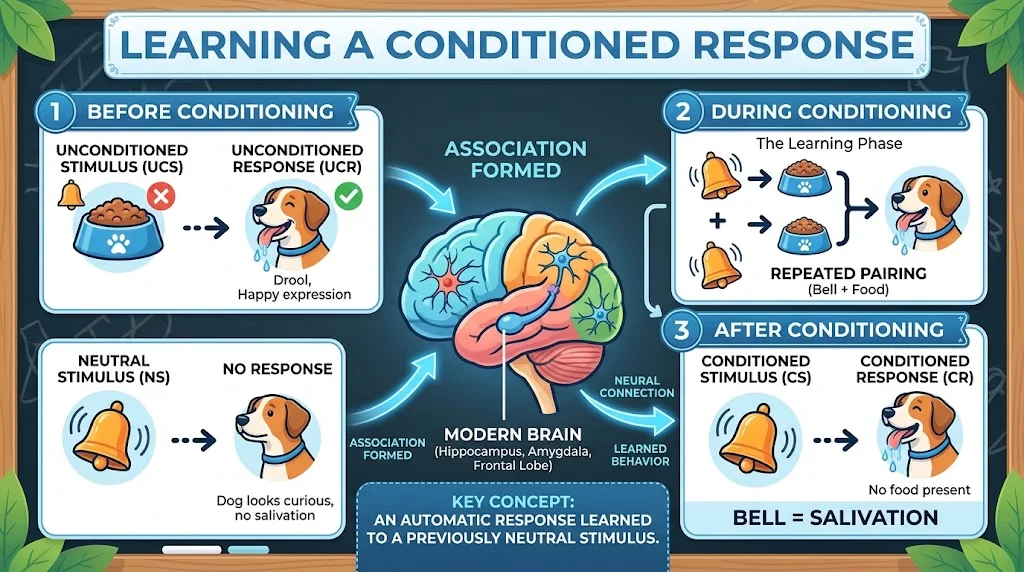
A conditioned response is a learned reaction that develops when a person or animal repeatedly associates one stimulus with another. In simple words, your brain learns to respond to something because of past experience.
Top alternatives: learned response, learned reaction, behavioral response, associated reaction, acquired response
Ever heard a sound, smelled something familiar, or walked into a certain place and instantly felt a reaction before you even thought about it? That is where the idea of a conditioned response gets interesting. Whether you are studying psychology, explaining a concept to a friend, answering a class question, or creating an easy example for a presentation, this term can sound much more complicated than it really is.
A conditioned response is basically a learned reaction created through association. Your brain connects one thing with another, and eventually that connection can trigger a response automatically. Think of it as your brain saying, “Yep, I remember where this is going.” Understanding what is a conditioned response becomes much easier when you connect the definition to everyday habits, routines, sounds, places, and experiences.
Simple Explanations
- “A conditioned response is a learned reaction.”
Example: Use this when someone wants the simplest possible definition.
Meaning: The response develops through learning rather than being automatic from birth. - “It is a reaction created through association.”
Example: Use this when explaining the concept in a psychology class.
Meaning: The brain connects two experiences and learns to react to one of them. - “Your brain learns the connection.”
Example: Use this when explaining the idea to someone unfamiliar with psychology.
Meaning: Repeated experiences can teach the brain to expect a particular outcome. - “It is basically a learned habit of responding.”
Example: Use this when someone wants an everyday explanation.
Meaning: The reaction becomes connected to a particular cue through experience. - “A conditioned response happens because of experience.”
Example: Use this when comparing learned and unlearned reactions.
Meaning: Past associations play a central role in creating the response. - “One thing starts triggering a reaction because of another thing.”
Example: Use this when explaining the concept casually.
Meaning: The response develops when two stimuli become associated. - “Your brain makes a connection and remembers it.”
Example: Use this when explaining conditioning to a beginner.
Meaning: Learning creates an association that can influence later reactions. - “It is a response you learn over time.”
Example: Use this when giving a short study definition.
Meaning: The reaction is acquired through repeated experience. - “Think of it as learned cause-and-effect.”
Example: Use this when someone wants a memorable explanation.
Meaning: The brain learns that one cue predicts another event. - “It is your brain connecting the dots.”
Example: Use this when making a psychology explanation more conversational.
Meaning: The brain associates different experiences. - “A conditioned response is not simply automatic from birth.”
Example: Use this when comparing it with an unconditioned response.
Meaning: Conditioning involves learning. - “It is a reaction shaped by association.”
Example: Use this in a concise academic explanation.
Meaning: The response develops because experiences become linked. - “Something becomes a trigger because you learned its meaning.”
Example: Use this when giving an everyday example.
Meaning: Previous experiences can make a neutral cue produce a response. - “Your past experiences can train your reactions.”
Example: Use this when explaining conditioning in everyday language.
Meaning: Repeated associations can influence future behavior. - “In short, it is a learned reaction to a learned cue.”
Example: Use this when summarizing the concept before a test.
Meaning: Conditioning creates a connection between a stimulus and a response.
Everyday Examples
- “A notification sound makes you check your phone.”
Example: Use this as an easy modern example of learned association.
Meaning: A familiar sound can become associated with receiving a message. - “The smell of popcorn makes you think about movies.”
Example: Use this when giving a relatable association example.
Meaning: Previous experiences can connect a smell with a particular setting. - “A school bell makes you prepare for the next class.”
Example: Use this when explaining learned reactions to students.
Meaning: Repeated routines can create predictable responses. - “A certain song reminds you of a specific memory.”
Example: Use this when explaining how associations form.
Meaning: Repeated experiences can connect music with memories and feelings. - “Seeing a gym can make you think about exercising.”
Example: Use this when giving a familiar environmental example.
Meaning: A place can become associated with a repeated activity. - “The smell of coffee can make you expect your morning routine.”
Example: Use this when explaining associations through daily habits.
Meaning: Repetition can connect a sensory cue with a routine. - “A school hallway can remind you that class is about to start.”
Example: Use this when explaining contextual cues.
Meaning: Places can become associated with predictable events. - “A particular ringtone can make you expect a specific person.”
Example: Use this when giving a technology-based example.
Meaning: Repeated pairing can create a strong association. - “A bedtime routine can make you feel ready to sleep.”
Example: Use this when explaining how repeated cues influence behavior.
Meaning: Familiar routines can become signals for what happens next. - “A uniform can make you think about work or school.”
Example: Use this when explaining environmental associations.
Meaning: Objects can become linked with particular situations. - “Opening a textbook can put you into study mode.”
Example: Use this when discussing learned cues.
Meaning: Repeated study routines can make certain cues signal concentration. - “The sound of an alarm can make you immediately wake up.”
Example: Use this when discussing learned routines.
Meaning: Repeated exposure can connect the sound with getting up. - “A particular place can remind you of past experiences.”
Example: Use this when explaining contextual learning.
Meaning: Environments can become connected with previous events. - “A familiar smell can instantly bring back a memory.”
Example: Use this when discussing sensory associations.
Meaning: Sensory cues can become strongly connected with past experiences. - “Seeing your sports equipment can put you into game mode.”
Example: Use this when giving a casual example.
Meaning: Repeated activities can make objects associated with a particular mindset.
Funny Examples
- “My phone buzzes and suddenly I’m employed as a professional checker.”
Example: Use this when joking about constantly checking notifications.
Meaning: Repeated notification experiences can create an automatic checking habit. - “The microwave beeps and I appear like magic.”
Example: Use this when joking about responding to familiar food cues.
Meaning: A repeated sound can become associated with something you want. - “The school bell rings and my brain clocks out.”
Example: Use this as a humorous classroom example.
Meaning: A familiar signal can trigger a learned reaction. - “Coffee appears and my personality loads.”
Example: Use this when joking about morning routines.
Meaning: Coffee has become associated with feeling ready for the day. - “My alarm rings and my hand immediately searches for snooze.”
Example: Use this as a funny example of a repeated morning routine.
Meaning: Repetition can make a response feel almost automatic. - “I hear the snack bag and suddenly I’m available.”
Example: Use this when joking about food-related cues.
Meaning: A familiar sound can become associated with something appealing. - “The group chat notification appears and chaos begins.”
Example: Use this when joking about predictable online reactions.
Meaning: The notification has become associated with an active conversation. - “My laptop opens and my procrastination activates.”
Example: Use this as a playful study example.
Meaning: Familiar routines can create predictable behavioral patterns. - “The weekend arrives and my productivity mysteriously disappears.”
Example: Use this when joking about routine changes.
Meaning: The cue of the weekend can become associated with relaxing. - “I smell pizza and suddenly I have opinions.”
Example: Use this as a playful sensory example.
Meaning: A familiar food cue can trigger an immediate reaction. - “One notification and my curiosity takes over.”
Example: Use this when joking about checking messages.
Meaning: Repeated notifications can create a strong checking response. - “The teacher says ‘pop quiz’ and my soul leaves the chat.”
Example: Use this as a humorous classroom example.
Meaning: A familiar phrase can trigger an immediate emotional reaction. - “The fridge opens and I suddenly need to investigate.”
Example: Use this as a funny household example.
Meaning: A familiar cue can trigger a predictable behavior. - “The bedtime alarm rings and I negotiate with tomorrow.”
Example: Use this when joking about sleep routines.
Meaning: A repeated bedtime cue can produce a familiar reaction. - “I hear footsteps in the kitchen and become a snack detective.”
Example: Use this as a playful example of learned association.
Meaning: A familiar sound becomes connected with the possibility of food.
School-Friendly Responses
- “A conditioned response is a learned reaction to a previously neutral stimulus.”
Example: Use this when writing a concise psychology assignment answer.
Meaning: Conditioning occurs when a neutral cue becomes associated with another stimulus. - “Classical conditioning explains how associations can create learned responses.”
Example: Use this when introducing the concept in a psychology lesson.
Meaning: Classical conditioning describes learning through stimulus associations. - “The response develops after repeated pairing.”
Example: Use this when explaining the learning process.
Meaning: Repeated association can cause a stimulus to trigger a learned response. - “The stimulus becomes meaningful through association.”
Example: Use this when discussing how conditioning works.
Meaning: Experience gives a previously neutral cue the ability to trigger a response. - “Learning changes how someone responds to a stimulus.”
Example: Use this when giving a simple classroom explanation.
Meaning: Experience can shape future reactions. - “Conditioning connects a stimulus with a predictable response.”
Example: Use this when summarizing the concept for study notes.
Meaning: The learned association makes a response more likely. - “The response is acquired rather than naturally present.”
Example: Use this when comparing conditioned and unconditioned responses.
Meaning: The response develops through learning. - “Repeated association can produce a learned reaction.”
Example: Use this when defining the mechanism simply.
Meaning: Pairing experiences can establish conditioning. - “A neutral stimulus can become a conditioned stimulus.”
Example: Use this when discussing classical conditioning terminology.
Meaning: A previously neutral cue can acquire the ability to trigger a learned response. - “The learned response can happen when the conditioned stimulus appears.”
Example: Use this when explaining the sequence of conditioning.
Meaning: The associated cue eventually produces the learned reaction. - “Classical conditioning is based on association.”
Example: Use this as a short study statement.
Meaning: Learning occurs when stimuli become connected. - “Experience can turn a neutral cue into a meaningful signal.”
Example: Use this when explaining the concept without technical language.
Meaning: Association gives the cue predictive meaning. - “The response develops because the brain learns a pattern.”
Example: Use this for an easy-to-understand classroom explanation.
Meaning: Repeated experiences help establish predictable connections. - “Conditioning shows how experience can influence behavior.”
Example: Use this when writing a short conclusion for a lesson.
Meaning: Learned associations can affect future responses. - “A conditioned response demonstrates learned behavior.”
Example: Use this as a concise definition in study notes.
Meaning: The reaction exists because of previous learning.
Professional Responses
- “A conditioned response is a learned behavioral or physiological reaction.”
Example: Use this when explaining the concept in a formal setting.
Meaning: The response is acquired through experience and association. - “The response develops through a learned association between stimuli.”
Example: Use this in a psychology presentation.
Meaning: Stimuli become connected through repeated pairing. - “Classical conditioning provides a framework for understanding conditioned responses.”
Example: Use this when discussing the concept academically.
Meaning: Classical conditioning explains how associations can produce learned reactions. - “The conditioned response is elicited by a conditioned stimulus.”
Example: Use this when using standard psychology terminology.
Meaning: The learned cue eventually triggers the learned response. - “A previously neutral stimulus may acquire response-eliciting properties.”
Example: Use this in a formal explanation.
Meaning: Association can give a neutral stimulus new significance. - “Repeated stimulus pairing can establish a conditioned response.”
Example: Use this when describing the learning process.
Meaning: Consistent associations can create a learned reaction. - “The response reflects experience-based learning.”
Example: Use this when summarizing the concept professionally.
Meaning: Previous experiences influence the person’s later response. - “Conditioned responses illustrate the role of association in learning.”
Example: Use this in a psychology discussion.
Meaning: The concept demonstrates how associations influence behavior. - “A learned stimulus-response relationship can develop through conditioning.”
Example: Use this when explaining behavioral learning.
Meaning: Conditioning establishes a connection between a cue and a reaction. - “The conditioned response differs from an unconditioned response because it is learned.”
Example: Use this when comparing two psychological concepts.
Meaning: Learning is the key distinction. - “Conditioning can alter responses to previously neutral cues.”
Example: Use this in an academic explanation.
Meaning: Learning can change how a person reacts to a stimulus. - “The learned association can influence subsequent behavior.”
Example: Use this when discussing behavioral consequences.
Meaning: Once established, an association may affect future actions. - “A conditioned response is an acquired response resulting from association.”
Example: Use this as a formal definition.
Meaning: The reaction develops through associative learning. - “The process demonstrates how environmental cues can influence behavior.”
Example: Use this when connecting conditioning to everyday behavior.
Meaning: External cues can become associated with predictable responses. - “Conditioned responses are an important concept in associative learning.”
Example: Use this when introducing the topic formally.
Meaning: They demonstrate how connections between experiences can shape reactions.
Short And Casual Responses
- “It’s basically a learned reaction.”
Example: Use this when a friend asks for a quick explanation.
Meaning: The response develops through experience. - “Your brain learned the connection.”
Example: Use this when explaining the concept casually.
Meaning: Association is responsible for the reaction. - “Think learned response.”
Example: Use this as a quick study reminder.
Meaning: It captures the central idea in two words. - “It’s a reaction you picked up over time.”
Example: Use this when explaining the term conversationally.
Meaning: The response develops through repeated experience. - “Basically, association at work.”
Example: Use this when summarizing the concept.
Meaning: The reaction comes from learned connections. - “Your brain connected two things.”
Example: Use this when explaining it to a beginner.
Meaning: The association between stimuli creates the response. - “It’s learned, not simply automatic.”
Example: Use this when distinguishing it from an innate response.
Meaning: Experience plays the key role. - “Experience taught the reaction.”
Example: Use this as a memorable study phrase.
Meaning: Past learning shaped the response. - “It’s your brain recognizing a pattern.”
Example: Use this when giving an everyday explanation.
Meaning: Repeated associations create predictable reactions. - “One cue starts triggering another response.”
Example: Use this when explaining conditioning simply.
Meaning: A learned cue becomes capable of producing a response. - “It’s a learned association.”
Example: Use this as a very short definition.
Meaning: The response comes from connecting experiences. - “Basically, your brain made a connection.”
Example: Use this when explaining the idea casually.
Meaning: The learned relationship produces the reaction. - “It happens because of past experience.”
Example: Use this when explaining why the reaction exists.
Meaning: Previous experiences established the association. - “It’s a response your brain learned.”
Example: Use this when explaining it to a younger student.
Meaning: The reaction was acquired through learning. - “Learned cue, learned reaction.”
Example: Use this as a quick revision phrase.
Meaning: Conditioning connects a cue with a learned response.
Clever Explanations
- “Your brain turns repetition into expectation.”
Example: Use this when explaining why repeated associations matter.
Meaning: Repeated experiences teach the brain what to anticipate. - “Association can turn an ordinary cue into a signal.”
Example: Use this when explaining conditioning creatively.
Meaning: A neutral stimulus can gain meaning through learning. - “Experience teaches the brain what to expect next.”
Example: Use this when explaining learned behavior.
Meaning: Repeated patterns can influence future responses. - “The cue becomes meaningful because of what came before it.”
Example: Use this when describing associative learning.
Meaning: Previous experiences give the cue its predictive significance. - “Conditioning is basically behavioral pattern recognition.”
Example: Use this when making the concept easier to remember.
Meaning: The brain learns relationships between repeated experiences. - “Your reaction can reveal what your brain has learned.”
Example: Use this when connecting conditioning to everyday behavior.
Meaning: Responses can reflect previous associations. - “A neutral cue can become a learned signal.”
Example: Use this when explaining classical conditioning.
Meaning: Association can give an ordinary stimulus a new function. - “Repeated pairing can rewrite what a cue means to you.”
Example: Use this when explaining how associations develop.
Meaning: Experience can change the significance of a stimulus. - “The brain remembers patterns, then reacts to them.”
Example: Use this when explaining the concept informally.
Meaning: Learned associations can influence later responses. - “The response makes sense once you know the association.”
Example: Use this when helping someone understand an unusual reaction.
Meaning: Past learning explains why the cue produces the response. - “Conditioning connects yesterday’s experience with today’s reaction.”
Example: Use this when explaining the role of previous learning.
Meaning: Earlier experiences can influence current behavior. - “A familiar cue can become a behavioral shortcut.”
Example: Use this when discussing learned routines.
Meaning: The cue can quickly activate a learned response. - “The brain learns the pattern before you consciously explain it.”
Example: Use this when describing automatic-feeling learned reactions.
Meaning: Learned associations can influence responses quickly. - “The reaction has a history.”
Example: Use this when explaining why a learned response exists.
Meaning: Previous experiences helped create the current reaction. - “What looks automatic may have been learned.”
Example: Use this when comparing conditioned and unconditioned reactions.
Meaning: Some seemingly automatic responses are products of experience.
Comparison With Unconditioned Responses
- “Conditioned means learned; unconditioned means naturally occurring.”
Example: Use this when explaining the basic difference.
Meaning: Learning separates the two concepts. - “A conditioned response comes from association.”
Example: Use this when defining the conditioned side of the comparison.
Meaning: The response develops through learning. - “An unconditioned response does not require prior conditioning.”
Example: Use this when explaining the contrast.
Meaning: It occurs naturally rather than being created through learned association. - “Conditioned responses are acquired through experience.”
Example: Use this in psychology study notes.
Meaning: Experience creates the response. - “Unconditioned responses happen without learning the association.”
Example: Use this when making the distinction clearer.
Meaning: They are not dependent on conditioning. - “Think learned versus natural.”
Example: Use this as a simple memory trick.
Meaning: It captures the central difference. - “Conditioning adds a learned connection.”
Example: Use this when comparing the two response types.
Meaning: Association is what creates the conditioned response. - “The conditioned response develops after experience.”
Example: Use this when explaining the timeline.
Meaning: Learning occurs before the response becomes established. - “The unconditioned response is not created by repeated pairing.”
Example: Use this when discussing classical conditioning.
Meaning: It occurs without the learned association. - “Conditioned responses depend on what has been learned.”
Example: Use this when reviewing psychology terminology.
Meaning: Past experience determines the learned reaction. - “An unconditioned response is not something you have to learn.”
Example: Use this when explaining the concept to a beginner.
Meaning: It occurs naturally. - “The key word is conditioning.”
Example: Use this when helping someone remember the distinction.
Meaning: Conditioning indicates that learning created the response. - “Conditioned responses are experience-based.”
Example: Use this in a short study answer.
Meaning: They arise through associative learning. - “Unconditioned responses occur without the learned cue-response relationship.”
Example: Use this in a more detailed classroom explanation.
Meaning: They do not depend on conditioning. - “If learning created the association, think conditioned.”
Example: Use this as a revision shortcut.
Meaning: Learning through association is the defining feature.
Emotional And Behavioral Examples
- “A familiar place can make you feel a certain way because of past experiences.”
Example: Use this when explaining how context can become associated with emotions.
Meaning: Previous experiences can influence later emotional reactions. - “A particular sound can make you feel alert because you associate it with something happening next.”
Example: Use this when explaining learned responses to sounds.
Meaning: The sound has gained meaning through repetition. - “A routine can create a predictable reaction.”
Example: Use this when discussing habits and conditioning.
Meaning: Repeated patterns can establish learned responses. - “A familiar environment can signal what comes next.”
Example: Use this when explaining contextual conditioning.
Meaning: Places can become associated with particular events. - “Repeated experiences can shape emotional reactions.”
Example: Use this when explaining conditioning broadly.
Meaning: Learning can influence how people respond emotionally. - “A cue can bring back a learned expectation.”
Example: Use this when discussing memory and association.
Meaning: The cue can activate an established connection. - “Your reaction may reflect something you learned earlier.”
Example: Use this when someone wonders why a cue affects them.
Meaning: Previous experiences may explain the response. - “Familiar signals can prepare you for what you expect.”
Example: Use this when explaining predictive associations.
Meaning: The brain can use learned cues to anticipate events. - “Repeated situations can make reactions feel automatic.”
Example: Use this when explaining why learned responses can seem effortless.
Meaning: Strong associations can produce quick reactions. - “An emotional response can become connected to a specific cue.”
Example: Use this when discussing learned emotional associations.
Meaning: Experience can link a cue with an emotional reaction. - “Context can influence how you respond.”
Example: Use this when explaining environmental learning.
Meaning: Surroundings can become associated with particular outcomes. - “Past associations can influence present behavior.”
Example: Use this in a psychology discussion.
Meaning: Earlier learning can affect current reactions. - “A learned cue can change how you approach a situation.”
Example: Use this when discussing behavioral conditioning.
Meaning: The cue can influence later behavior. - “Repeated associations can make a response easier to trigger.”
Example: Use this when explaining conditioning strength.
Meaning: Learning can make the connection more established. - “Your environment can become part of what your brain expects.”
Example: Use this when explaining contextual cues.
Meaning: Surroundings can acquire meaning through repeated experience.
Study-Friendly Responses
- “Remember: conditioned equals learned.”
Example: Use this as a quick revision trick before a psychology quiz.
Meaning: Learning is the defining feature of a conditioned response. - “Think association plus reaction.”
Example: Use this when memorizing the concept.
Meaning: A learned association produces the response. - “Neutral cue plus learning can lead to a conditioned response.”
Example: Use this when reviewing classical conditioning.
Meaning: Association can give a neutral stimulus the ability to trigger a learned reaction. - “Classical conditioning is the key topic.”
Example: Use this when organizing psychology study notes.
Meaning: Conditioned responses are central to classical conditioning. - “Conditioned means acquired through experience.”
Example: Use this as a flashcard definition.
Meaning: The response is learned rather than innate. - “Unconditioned is natural; conditioned is learned.”
Example: Use this when memorizing the comparison.
Meaning: It summarizes the primary distinction. - “A conditioned stimulus triggers the conditioned response.”
Example: Use this when reviewing key terminology.
Meaning: The learned stimulus produces the learned reaction. - “Association is the memory word.”
Example: Use this when trying to remember the mechanism.
Meaning: Conditioning depends on connecting stimuli. - “Repeated pairing builds the association.”
Example: Use this when reviewing how conditioning develops.
Meaning: Repeated exposure can strengthen the learned connection. - “The response is learned through experience.”
Example: Use this as a short-answer exam definition.
Meaning: Experience is responsible for creating the response. - “Conditioning changes how a stimulus is understood.”
Example: Use this when reviewing the role of learning.
Meaning: A previously neutral cue can acquire significance. - “Cue, association, response.”
Example: Use this as a three-word study reminder.
Meaning: It summarizes the basic learning sequence. - “Learn the association, then expect the response.”
Example: Use this when creating a study mnemonic.
Meaning: The learned connection helps explain the later reaction. - “Conditioned responses are examples of associative learning.”
Example: Use this in a psychology revision session.
Meaning: They demonstrate learning through connections between stimuli. - “The big idea is simple: experience changes reactions.”
Example: Use this when simplifying the topic for revision.
Meaning: Conditioning shows how learning can shape responses.
FAQs
What Is A Conditioned Response?
A conditioned response is a learned reaction that develops through association. A stimulus that was initially neutral can eventually trigger a response after being repeatedly associated with another stimulus.
Is A Conditioned Response Learned Or Natural?
It is learned. That is the main difference between a conditioned response and an unconditioned response, which occurs naturally without prior conditioning.
What Is A Simple Example?
A familiar sound repeatedly associated with an event can eventually trigger anticipation or another learned reaction. The key is that the response develops because of the association.
What Is Classical Conditioning?
Classical conditioning is a form of associative learning in which a connection develops between stimuli. It is commonly associated with the work of Ivan Pavlov.
Can A Conditioned Response Be Emotional?
Yes. Learned associations can influence emotional reactions as well as behavioral or physiological responses.
Conclusion
Understanding what is a conditioned response becomes much easier when you stop thinking of it as complicated psychology vocabulary and start thinking about learned associations. Your brain experiences something repeatedly, connects it with another event, and eventually a familiar cue can produce a learned reaction.
That basic idea explains why certain sounds, places, routines, and situations can influence how you respond. When studying the topic, remember the easiest shortcut: conditioned means learned, while unconditioned means naturally occurring. Use everyday examples to make the concept stick, especially when preparing for a quiz or explaining it to someone else. Save this guide for revision, share it with a classmate, and keep the simple definition handy whenever psychology gets confusing.
