Quick Answer
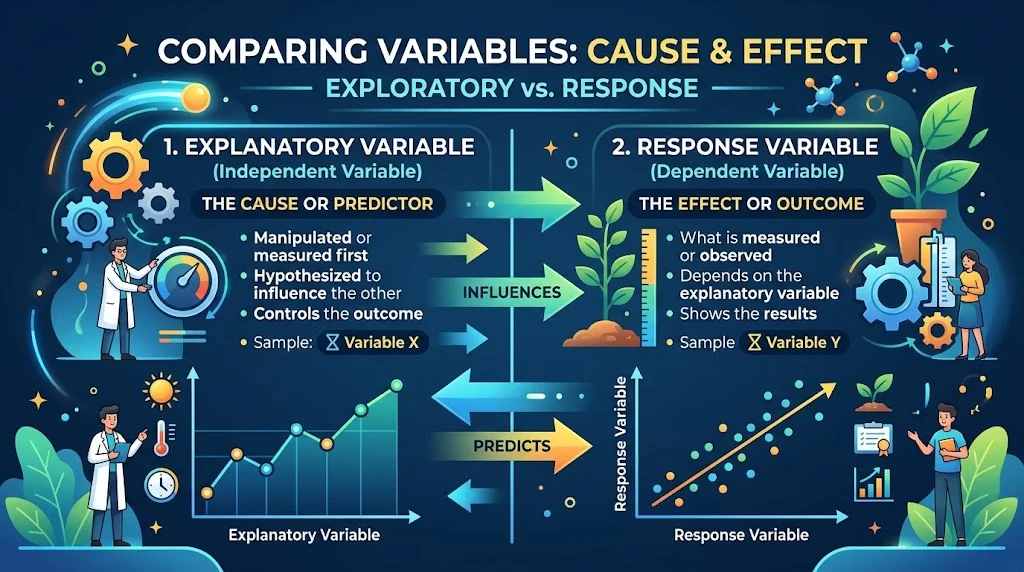
A response variable is the outcome you measure, while an explanatory variable is the factor you use to explain or predict changes in that outcome. Think of it as “what changes” versus “what might explain the change.”
Top alternatives: dependent vs independent variable, outcome vs predictor variable, explained vs explanatory variable, measured vs predictor variable, response vs predictor
Ever stare at a statistics question and think, “Okay, but which variable is which?” You are definitely not alone. The difference between a response variable vs explanatory variable sounds more complicated than it actually is, especially when you are dealing with homework, research questions, experiments, graphs, or exam prep. The trick is to identify what you are measuring and what you think might explain or predict that measurement.
One variable is the outcome you care about, while the other provides a possible explanation for changes in that outcome. Once you spot that relationship, the whole question becomes much easier. Whether you need a quick classroom explanation, a clever memory trick, or a simple way to explain it to a friend, this guide gives you ready-to-use responses for different situations. No statistical panic required.
Funny Responses
- “One explains, one gets explained.”
Example: Use this when a classmate asks for the fastest way to remember the difference.
Meaning: The explanatory variable helps explain the response variable. - “X asks the question, Y gives the answer.”
Example: Use this when simplifying variables for a friend.
Meaning: It presents the explanatory variable as the possible influence and the response variable as the outcome. - “One is the suspect, one is the evidence.”
Example: Use this when making a statistics lesson more entertaining.
Meaning: The explanatory variable is treated as a possible explanation, while the response variable is what you observe. - “Basically, one does the explaining and one gets the spotlight.”
Example: Use this when someone is confused about which variable is the outcome.
Meaning: The explanatory variable provides context while the response variable is the measured outcome. - “Statistics really said, ‘Who caused this?’”
Example: Use this when introducing an explanatory and response variable question.
Meaning: It humorously describes the goal of examining relationships between variables. - “Response variable: the main character.”
Example: Use this when helping someone remember which variable is the outcome.
Meaning: The response variable is the result being measured. - “Explanatory variable: the character with the clues.”
Example: Use this when explaining the relationship playfully.
Meaning: It represents the factor that may help explain the outcome. - “Think cause clue and outcome.”
Example: Use this when giving someone a quick memory shortcut.
Meaning: It connects the explanatory variable with a possible influence and the response variable with the outcome. - “One predicts, one responds.”
Example: Use this when someone wants a super-short explanation.
Meaning: The explanatory variable can be used to predict the response variable. - “Tiny statistics lesson, zero drama.”
Example: Use this when a classmate is overcomplicating the question.
Meaning: It suggests the distinction can be simple. - “The response variable is literally here to respond.”
Example: Use this when explaining the name itself.
Meaning: Its value is the outcome being studied in relation to another variable. - “Explanatory means it has some explaining to do.”
Example: Use this as a playful vocabulary trick.
Meaning: The name hints that the variable helps explain variation in the response. - “No variable left behind.”
Example: Use this when working through a confusing statistics problem.
Meaning: Both variables have different roles in the analysis. - “Find the outcome, then find its possible explanation.”
Example: Use this when teaching someone the basic method.
Meaning: It gives a simple way to identify the two variables. - “Statistics, but make it detective mode.”
Example: Use this when introducing a relationship between two variables.
Meaning: It frames the explanatory variable as a possible clue to the response.
Brutal Responses
- “Stop memorizing names and identify the outcome.”
Example: Use this when someone keeps mixing up the terminology.
Meaning: The actual role of each variable matters more than memorizing labels. - “If you cannot find the outcome, you are not ready to label the variables.”
Example: Use this when someone labels variables before understanding the question.
Meaning: The response variable should be identified from the research context first. - “The word ‘response’ is doing most of the work here.”
Example: Use this when someone needs a direct memory trick.
Meaning: The response variable is the measured outcome. - “Read the question before blaming the variables.”
Example: Use this when someone is guessing which variable is explanatory.
Meaning: Context determines each variable’s role. - “Not every variable is automatically the cause.”
Example: Use this when someone assumes an explanatory variable proves causation.
Meaning: An explanatory relationship does not automatically establish a causal relationship. - “Prediction is not proof of causation.”
Example: Use this when discussing observational data.
Meaning: A variable can help predict an outcome without causing it. - “If it is the outcome you measure, it is the response variable.”
Example: Use this when someone is stuck on terminology.
Meaning: The measured result is the key identifier. - “Do not call something explanatory just because it appears first.”
Example: Use this when someone labels variables based on their order in a question.
Meaning: Position does not determine the statistical role. - “Context beats alphabet soup.”
Example: Use this when someone relies only on X and Y labels.
Meaning: Variable roles depend on the research question, not merely their symbols. - “X and Y are not magical labels.”
Example: Use this when someone thinks X always means explanatory and Y always means response.
Meaning: Symbols can vary depending on the problem. - “Find what you measured. Then stop guessing.”
Example: Use this when someone is rushing through an assignment.
Meaning: Identifying the measured outcome is the fastest reliable starting point. - “A relationship does not automatically mean one variable caused another.”
Example: Use this when someone makes a causal claim from an association.
Meaning: Association and causation are different concepts. - “The variable names are not the hard part.”
Example: Use this when someone feels overwhelmed.
Meaning: Understanding the roles is more important than memorizing terminology. - “If you know the research question, the labels get easier.”
Example: Use this when someone cannot distinguish the variables.
Meaning: The purpose of the study helps determine their roles. - “Stop treating statistics like a vocabulary test.”
Example: Use this when someone is only memorizing definitions.
Meaning: Understanding the relationship is more useful than rote memorization.
Polite Responses
- “The response variable is the outcome being measured.”
Example: Use this when giving a straightforward classroom explanation.
Meaning: It identifies the response variable by its primary role. - “The explanatory variable is the factor used to help explain variation in the response.”
Example: Use this when explaining the concept formally but simply.
Meaning: It describes the explanatory variable’s purpose. - “A useful way to remember it is outcome versus possible explanation.”
Example: Use this when someone wants an easy memory aid.
Meaning: It summarizes the distinction without complicated terminology. - “Start by asking what the study is measuring.”
Example: Use this when helping someone identify the response variable.
Meaning: The measured outcome is usually the response variable. - “Then ask which variable might help explain differences in that outcome.”
Example: Use this when identifying the explanatory variable.
Meaning: It directs attention to the potential predictor. - “The two variables have different roles in the research question.”
Example: Use this when correcting a misunderstanding.
Meaning: Their labels depend on their roles. - “The response variable is sometimes called the outcome variable.”
Example: Use this when someone has encountered different terminology.
Meaning: These terms commonly refer to the variable being studied as the result. - “The explanatory variable can also be described as a predictor.”
Example: Use this when connecting statistics vocabulary.
Meaning: A predictor is used to help explain or predict the response. - “It helps to identify the outcome before assigning labels.”
Example: Use this when someone is unsure where to begin.
Meaning: The outcome provides a reliable starting point. - “The names can vary, but the roles remain the important part.”
Example: Use this when a textbook uses different terminology.
Meaning: Different statistical terms can describe similar roles. - “Look at the question being investigated rather than the variable names alone.”
Example: Use this when someone is confused by notation.
Meaning: Context determines the roles. - “An explanatory variable does not necessarily prove causation.”
Example: Use this when discussing relationships between variables.
Meaning: Explanation in statistical modeling is not automatically causal. - “A simple example can make the difference much clearer.”
Example: Use this before giving a study example.
Meaning: Concrete examples often make abstract terminology easier. - “Think of the response as the result you want to understand.”
Example: Use this when teaching the concept to a beginner.
Meaning: It gives an intuitive definition of the response variable. - “Think of the explanatory variable as information that may help explain that result.”
Example: Use this when completing the comparison.
Meaning: It gives an intuitive definition of the explanatory variable.
Professional Responses
- “The response variable represents the outcome measured in the analysis.”
Example: Use this in a formal report discussing a statistical model.
Meaning: It defines the response variable precisely. - “The explanatory variable is used to examine or model variation in the response.”
Example: Use this when describing an analytical method.
Meaning: It explains the role of the predictor. - “The distinction should be based on the research question.”
Example: Use this when variables could reasonably be interpreted in different ways.
Meaning: Context determines their roles. - “A response variable is often referred to as an outcome variable.”
Example: Use this when writing for an audience familiar with multiple statistical terms.
Meaning: It connects equivalent terminology. - “An explanatory variable may also be called a predictor variable.”
Example: Use this in a statistics discussion involving regression.
Meaning: It connects explanatory and predictive terminology. - “The explanatory variable is not necessarily a causal variable.”
Example: Use this when discussing observational research.
Meaning: Statistical explanation does not by itself establish causation. - “The response is the quantity whose variation is being examined.”
Example: Use this when describing an analytical framework.
Meaning: It identifies the measured outcome. - “The explanatory variable provides information that may account for differences in the response.”
Example: Use this when explaining a model to colleagues.
Meaning: It describes how the predictor relates to the outcome. - “Variable roles depend on the analytical question.”
Example: Use this when the same variables appear in different studies.
Meaning: A variable can occupy different roles in different analyses. - “Correlation between two variables does not establish causation.”
Example: Use this when interpreting observational findings.
Meaning: Association alone cannot prove a causal mechanism. - “The response variable is generally placed on the outcome side of the research question.”
Example: Use this when teaching study design.
Meaning: It helps identify the measured result. - “The explanatory variable is considered in relation to the response.”
Example: Use this when describing a statistical relationship.
Meaning: The predictor is interpreted through its relationship with the outcome. - “Clear variable definitions improve the interpretation of statistical results.”
Example: Use this when preparing a research report.
Meaning: Precise terminology supports clearer analysis. - “The distinction is conceptual rather than simply a matter of notation.”
Example: Use this when someone assumes X and Y automatically determine roles.
Meaning: The statistical purpose matters more than the symbols. - “Always describe what each variable represents before interpreting the relationship.”
Example: Use this when explaining a data analysis.
Meaning: Definitions should come before conclusions.
Creative Responses
- “Meet the detective and the mystery.”
Example: Use this as a memorable way to introduce the two variables.
Meaning: The explanatory variable is like a clue, while the response is what needs explaining. - “The explanatory variable brings the clues, the response brings the result.”
Example: Use this when teaching the distinction creatively.
Meaning: It gives each variable a memorable role. - “Think question and answer.”
Example: Use this when someone needs a simple mental picture.
Meaning: The explanatory variable helps frame what might explain the outcome. - “Think input and outcome, but keep the context in charge.”
Example: Use this when explaining the relationship in a simple way.
Meaning: It provides an intuitive comparison while avoiding rigid labeling. - “One variable tells the story, the other shows what happened.”
Example: Use this when describing a research example.
Meaning: The explanatory variable provides context and the response shows the measured outcome. - “The predictor knocks, the response opens the door.”
Example: Use this when making a statistics lesson memorable.
Meaning: The predictor is considered in relation to the outcome. - “Think of it as clue versus outcome.”
Example: Use this when introducing the terms to a beginner.
Meaning: It gives a simple conceptual distinction. - “Response is the destination, explanatory is the road sign.”
Example: Use this when creating a visual memory trick.
Meaning: The explanatory variable provides information about the response. - “The response is what you watch; the explanatory variable is what you watch it alongside.”
Example: Use this when explaining a graph.
Meaning: It highlights the relationship between the measured outcome and predictor. - “Statistics has its own detective story.”
Example: Use this when introducing correlation or regression.
Meaning: Statistical analysis can investigate relationships between variables. - “Find the result, then ask what might explain it.”
Example: Use this as a memorable two-step method.
Meaning: It gives a practical identification strategy. - “One variable gives context, the other gives the outcome.”
Example: Use this when summarizing the distinction.
Meaning: It separates the roles clearly. - “The response is the headline; the explanatory variable is part of the story behind it.”
Example: Use this in a classroom presentation.
Meaning: It makes the relationship easier to visualize. - “Think outcome first, explanation second.”
Example: Use this when someone needs a quick memory trick.
Meaning: It provides a simple identification order. - “Two variables, two jobs, one relationship.”
Example: Use this when wrapping up an explanation.
Meaning: It emphasizes that the variables have distinct roles within the same analysis.
Sarcastic Responses
- “Because apparently statistics needed two names for this.”
Example: Use this when a friend complains about the terminology.
Meaning: It jokes about the number of statistical labels. - “Welcome to statistics, where simple ideas get fancy names.”
Example: Use this when introducing the terminology to a beginner.
Meaning: It humorously comments on technical vocabulary. - “Of course we could not just call it the outcome.”
Example: Use this when someone finds the terminology unnecessarily complicated.
Meaning: It jokes about formal statistical language. - “Nothing says fun like identifying variables.”
Example: Use this when starting a statistics assignment.
Meaning: It playfully complains about the task. - “Because ‘what happened’ was apparently too easy.”
Example: Use this when explaining the response variable.
Meaning: It jokes about the technical term for an outcome. - “Statistics really loves a vocabulary upgrade.”
Example: Use this when someone learns another term for a familiar concept.
Meaning: It humorously highlights the specialized terminology. - “One predicts, one responds, and everyone gets homework.”
Example: Use this when studying for a statistics class.
Meaning: It turns the variable distinction into a relatable joke. - “Nothing suspicious here, just variables explaining variables.”
Example: Use this when discussing a statistical relationship.
Meaning: It makes the analytical process sound playfully mysterious. - “Yes, the names are different. No, statistics will not make it easy.”
Example: Use this when a classmate is frustrated by terminology.
Meaning: It humorously acknowledges the learning curve. - “Because apparently ‘predictor’ needed another outfit.”
Example: Use this when comparing predictor and explanatory terminology.
Meaning: It jokes that multiple terms can describe related roles. - “Welcome to the part where X and Y become everyone’s problem.”
Example: Use this when beginning a variable-identification exercise.
Meaning: It humorously describes a common statistics challenge. - “The variables have entered their professional era.”
Example: Use this when introducing formal statistical vocabulary.
Meaning: It jokes about ordinary ideas receiving technical names. - “One variable explains, the other suffers through the analysis.”
Example: Use this when making a study session lighter.
Meaning: It playfully assigns personalities to the variables. - “Correlation walked so regression could run.”
Example: Use this when discussing related statistical concepts.
Meaning: It uses internet-style phrasing to make the topic memorable. - “Statistics really said, ‘Let’s make this unnecessarily official.’”
Example: Use this when someone finds the terminology intimidating.
Meaning: It humorously frames the formal vocabulary as complicated.
Cute Responses
- “Think of them as a little statistics team.”
Example: Use this when explaining the variables to a beginner.
Meaning: It makes the relationship feel approachable. - “One asks ‘why might this change?’ and one says ‘here is what changed.’”
Example: Use this when teaching the basic idea.
Meaning: It gives each variable a friendly role. - “The response variable is the result we care about.”
Example: Use this when giving a simple definition.
Meaning: It highlights the importance of the measured outcome. - “The explanatory variable helps us understand that result.”
Example: Use this when completing the explanation.
Meaning: It describes the predictor’s role. - “Think of one as the clue and one as the answer.”
Example: Use this when someone needs an easy memory trick.
Meaning: It makes the distinction easier to remember. - “You can totally get this.”
Example: Use this when a friend feels overwhelmed by statistics.
Meaning: It provides encouragement. - “Start with the result, then work backward.”
Example: Use this when showing someone how to identify variables.
Meaning: It offers a simple practical method. - “No scary statistics vocabulary required.”
Example: Use this when helping a beginner understand the concept.
Meaning: It reassures them that the basic idea is simple. - “One little distinction, huge clarity.”
Example: Use this when summarizing the concept.
Meaning: It emphasizes how useful the distinction can be. - “Outcome first, predictor next.”
Example: Use this as a short memory phrase.
Meaning: It gives an easy identification order. - “Once you spot the outcome, the rest gets easier.”
Example: Use this when someone is stuck on a homework question.
Meaning: It encourages starting with the response variable. - “You are closer than you think.”
Example: Use this when someone feels confused.
Meaning: It offers encouragement during learning. - “Keep it simple: what changed, and what might explain it?”
Example: Use this when simplifying the lesson.
Meaning: It captures the core relationship. - “Statistics can be friendly too.”
Example: Use this when making a study guide more approachable.
Meaning: It encourages a less intimidating view of statistics. - “Two roles, one easy trick.”
Example: Use this when wrapping up the explanation.
Meaning: It summarizes the simple distinction.
Dramatic Responses
- “And now, the great variable mystery begins.”
Example: Use this when starting a statistics problem.
Meaning: It playfully exaggerates the task. - “One outcome. One possible explanation. Let the analysis begin.”
Example: Use this when introducing a research example.
Meaning: It summarizes the relationship dramatically. - “The response variable has entered the spotlight.”
Example: Use this when identifying the outcome in a dataset.
Meaning: It emphasizes the variable being measured. - “Meanwhile, the explanatory variable arrives with clues.”
Example: Use this when introducing the predictor.
Meaning: It portrays the explanatory variable as a source of information. - “The data has questions, and statistics wants answers.”
Example: Use this when beginning an analysis.
Meaning: It dramatizes the purpose of statistical investigation. - “The outcome has been revealed.”
Example: Use this when identifying the response variable.
Meaning: It humorously treats the measured result as a dramatic reveal. - “Cue the regression soundtrack.”
Example: Use this when moving into a regression example.
Meaning: It adds playful drama to the statistical method. - “The variables have officially taken their positions.”
Example: Use this when labeling variables in a study.
Meaning: It emphasizes that each has a different analytical role. - “One variable may hold the clue we need.”
Example: Use this when introducing an explanatory variable.
Meaning: It highlights its potential role in explaining variation. - “The response stands before the statistical jury.”
Example: Use this when discussing an outcome in an analysis.
Meaning: It playfully frames the analysis as an investigation. - “The evidence is in the data.”
Example: Use this when moving from a hypothesis to analysis.
Meaning: It emphasizes using data rather than assumptions. - “And suddenly, the graph has a storyline.”
Example: Use this when interpreting a scatterplot.
Meaning: It makes the relationship between variables feel more intuitive. - “The predictor approaches. The outcome responds.”
Example: Use this when summarizing the roles dramatically.
Meaning: It provides a memorable contrast. - “The statistics saga continues.”
Example: Use this when moving to the next problem.
Meaning: It humorously acknowledges an ongoing study session. - “Two variables enter. One relationship emerges.”
Example: Use this when introducing a data analysis.
Meaning: It emphasizes the relationship being studied.
Chill And Casual Responses
- “Think outcome versus predictor.”
Example: Use this when someone wants the shortest explanation.
Meaning: It gives the basic distinction in a few words. - “Response is what you measure.”
Example: Use this when answering a quick homework question.
Meaning: It identifies the response variable directly. - “Explanatory is what you use to help explain it.”
Example: Use this when explaining the second variable.
Meaning: It gives an intuitive definition. - “Find the result first.”
Example: Use this when someone does not know where to start.
Meaning: The outcome helps identify the response variable. - “Then find what might predict that result.”
Example: Use this when identifying the explanatory variable.
Meaning: It points toward the predictor. - “That is basically the whole trick.”
Example: Use this when summarizing the concept.
Meaning: It reassures the learner that the distinction is manageable. - “Do not overthink the labels.”
Example: Use this when someone is stuck on terminology.
Meaning: The roles matter more than the names. - “Context tells you which is which.”
Example: Use this when variables appear ambiguous.
Meaning: Their roles depend on the research question. - “Outcome equals response.”
Example: Use this as a quick study note.
Meaning: It provides a simple memory connection. - “Predictor points toward response.”
Example: Use this when explaining the relationship casually.
Meaning: It shows the directional structure of the analysis. - “Easy enough once you see the pattern.”
Example: Use this when encouraging a classmate.
Meaning: It reassures them that practice helps. - “Just ask what you are trying to explain.”
Example: Use this when someone cannot identify the response variable.
Meaning: The target of explanation is generally the response. - “Then ask what might help explain it.”
Example: Use this when identifying the explanatory variable.
Meaning: It provides the second step. - “No statistical meltdown required.”
Example: Use this when a friend feels overwhelmed.
Meaning: It adds humor while reassuring them. - “You have got the basic idea now.”
Example: Use this after explaining the distinction.
Meaning: It provides casual encouragement.
Confident Responses
- “The response variable is the outcome.”
Example: Use this when answering confidently in class.
Meaning: It states the core definition directly. - “The explanatory variable helps account for variation in that outcome.”
Example: Use this when giving a more complete explanation.
Meaning: It accurately describes the predictor’s role. - “Identify the outcome first, and the distinction becomes much clearer.”
Example: Use this when teaching someone your method.
Meaning: It gives a confident strategy. - “Do not confuse association with causation.”
Example: Use this when interpreting observational data.
Meaning: It emphasizes an important statistical limitation. - “The research question determines the variable roles.”
Example: Use this when discussing different study designs.
Meaning: It explains why labels are context-dependent. - “The response variable is what the analysis is trying to understand.”
Example: Use this when explaining the concept to a classmate.
Meaning: It provides a practical definition. - “The explanatory variable is information used to model or explain the response.”
Example: Use this when describing statistical analysis.
Meaning: It explains the predictor’s function. - “The symbols do not determine the roles.”
Example: Use this when someone assumes X must always be explanatory.
Meaning: Variable notation can vary. - “Use the question, not guesswork.”
Example: Use this when identifying variables quickly.
Meaning: The research context should guide the answer. - “If you can state the outcome, you can usually identify the response.”
Example: Use this when solving a homework problem.
Meaning: The measured outcome provides a reliable clue. - “Prediction does not automatically mean causation.”
Example: Use this when discussing regression or observational studies.
Meaning: Predictive relationships should not automatically be interpreted as causal. - “A variable can play different roles in different research questions.”
Example: Use this when comparing two studies.
Meaning: Variable roles are contextual. - “The terminology is easier once the relationship is clear.”
Example: Use this when helping someone memorize definitions.
Meaning: Understanding comes before memorization. - “Outcome first. Explanation second. That is the shortcut.”
Example: Use this as a study tip.
Meaning: It gives a simple process for identifying the variables. - “Once the roles are clear, the labels are easy.”
Example: Use this when concluding an explanation.
Meaning: Conceptual understanding makes terminology easier.
Emotional Responses
- “Statistics can feel confusing at first, and that is completely normal.”
Example: Use this when encouraging someone struggling with the topic.
Meaning: It normalizes the learning process. - “You do not have to understand everything instantly.”
Example: Use this when a classmate feels frustrated.
Meaning: It encourages patience. - “Start with one question: what is the outcome?”
Example: Use this when someone feels overwhelmed by a problem.
Meaning: It gives them a manageable first step. - “Once you find the outcome, take it one step at a time.”
Example: Use this when guiding someone through an assignment.
Meaning: It breaks the task into smaller parts. - “You are not bad at statistics just because the terminology feels weird.”
Example: Use this when a friend doubts their ability.
Meaning: It separates difficulty with vocabulary from ability. - “Confusion is part of learning complicated concepts.”
Example: Use this when someone gets an answer wrong.
Meaning: It frames mistakes as part of learning. - “You can absolutely learn this.”
Example: Use this when motivating someone before a test.
Meaning: It gives direct encouragement. - “The names sound scarier than the idea.”
Example: Use this when someone is intimidated by the terms.
Meaning: It reassures them that the underlying concept is simpler. - “Give yourself a second to identify the outcome.”
Example: Use this when someone rushes through questions.
Meaning: It encourages a calmer approach. - “You only need to find the relationship first.”
Example: Use this when the terminology feels overwhelming.
Meaning: Understanding the relationship simplifies the labels. - “One confusing question does not define your statistics skills.”
Example: Use this when someone gets stuck on an assignment.
Meaning: It encourages perspective. - “Take a breath and read the research question again.”
Example: Use this when someone is panicking over a problem.
Meaning: It encourages them to slow down and use context. - “You are closer to the answer than you think.”
Example: Use this when someone has identified most of the problem correctly.
Meaning: It provides encouragement. - “It gets easier with examples.”
Example: Use this when someone is struggling with abstract definitions.
Meaning: It suggests learning through practical cases. - “Keep going. The pattern will click.”
Example: Use this when encouraging continued practice.
Meaning: It reinforces persistence.
FAQs
What Is A Response Variable?
A response variable is the outcome or measurement you are interested in understanding or predicting.
What Is An Explanatory Variable?
An explanatory variable is a variable used to help explain or predict variation in the response variable.
Is A Response Variable The Same As A Dependent Variable?
Often, yes. In many statistical contexts, “response variable” and “dependent variable” describe the outcome being studied, although terminology can vary by field.
Is An Explanatory Variable The Same As An Independent Variable?
They can refer to similar roles, but the terms are not always interchangeable in every statistical context. “Explanatory variable” emphasizes the variable’s role in explaining or predicting the response.
Which Variable Goes On The Y Axis?
In many standard graphs, the response variable is placed on the vertical or y axis, while the explanatory variable is placed on the horizontal or x axis.
Conclusion
Understanding response variable vs explanatory variable becomes much easier once you stop treating the terms like random statistics vocabulary. Start by finding the outcome you are measuring. That is generally your response variable. Then identify the factor that may help explain or predict changes in that outcome. That is your explanatory variable.
Keep in mind that an explanatory relationship does not automatically prove causation, especially in observational studies. When you practice with real examples, the difference quickly becomes more natural. Save this guide for homework, revision, or that inevitable moment when statistics suddenly looks like another language. Share it with a classmate, bookmark it for later, and keep practicing until the distinction feels effortless.
Discover More Related Articles:
- Managed Threat Detection And Response | Meanings & Professional Phrases In 2026
- Primary vs Secondary Immune Response | Explanations & Comparisons In 2026
