Quick Answer
Response to stimuli means how a living organism reacts to a change in its environment. A stimulus can be light, sound, temperature, touch, or another signal that causes a reaction.
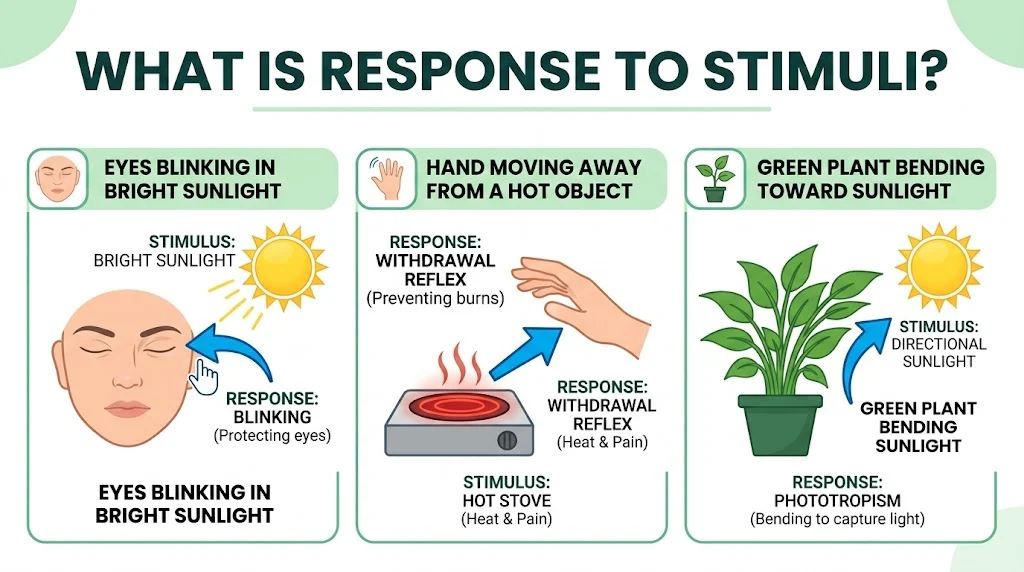
Simple examples: Pulling your hand away from something hot, blinking in bright light, a plant bending toward sunlight, sweating in hot weather, and moving toward a familiar voice.
Have you ever blinked when a bright light hit your eyes, jumped at a sudden noise, or pulled your hand away from something hot? These everyday reactions are examples of a response to stimuli. Your body and brain constantly receive information from the environment and react to it, often without you even thinking about it. Plants and animals also respond to changes around them, helping them survive and adapt.
Understanding what is response to stimuli makes it easier to learn basic biology, explain human behavior, and recognize how living things interact with their surroundings. Whether you need a simple definition for school, examples for a science assignment, or an easy way to remember the concept, this guide breaks everything down into clear explanations and relatable examples.
Simple Responses to Stimuli
– “I blink when a bright light shines in my eyes.” Example: Use this example in a biology assignment about human reactions. Meaning: The eyes respond to bright light by blinking or adjusting to it.
– “I pull my hand away from something hot.” Example: Use this when explaining how the body responds to heat. Meaning: The body reacts quickly to a potentially harmful temperature.
– “I turn around when someone calls my name.” Example: Use this when describing a reaction to sound. Meaning: The ears detect a sound, and the person responds by turning.
– “I start sweating when the weather gets hot.” Example: Use this to explain how the body reacts to temperature changes. Meaning: Sweating helps regulate body temperature.
– “I shiver when I feel cold.” Example: Use this when describing the body’s response to cold weather. Meaning: Shivering helps the body generate heat.
– “I sneeze when something irritates my nose.” Example: Use this in a lesson about automatic bodily reactions. Meaning: Sneezing helps clear irritants from the nasal passages.
– “I move toward the sound of my favorite song.” Example: Use this when explaining a behavioral reaction to music. Meaning: The sound influences a person’s behavior.
– “I close my eyes when dust gets near them.” Example: Use this when discussing protective reflexes. Meaning: The body reacts to help protect the eyes.
– “I feel hungry when I have not eaten for a while.” Example: Use this to describe an internal signal. Meaning: Changes inside the body can trigger a response.
– “A plant bends toward sunlight.” Example: Use this in a lesson about plant behavior. Meaning: The plant grows toward light through a response called phototropism.
– “A snail pulls into its shell when disturbed.” Example: Use this as an example of an animal reacting to touch or danger. Meaning: The snail responds by adopting a protective behavior.
– “My pupils become smaller in bright light.” Example: Use this when describing how the eyes adjust to different lighting. Meaning: The pupils constrict in response to bright light.
– “I startle when a door slams unexpectedly.” Example: Use this when explaining a sudden reaction to noise. Meaning: The nervous system responds to an unexpected sound.
– “A Venus flytrap closes when an insect touches its trigger hairs.” Example: Use this when studying unusual plant responses. Meaning: The plant responds to mechanical stimulation.
– “I drink water when I feel thirsty.” Example: Use this when describing a response to an internal body signal. Meaning: Thirst encourages the body to replace needed fluids.
Funny Responses to Stimuli
– “My alarm rings, and my soul leaves the chat.” Example: Use this in a funny school presentation about waking up. Meaning: It humorously describes a reaction to a loud sound.
– “Bright sunlight appears, and I become a professional squinter.” Example: Use this when talking about sunlight outdoors. Meaning: It describes the eyes reacting to bright light.
– “Someone mentions food, and suddenly I am listening.” Example: Use this when explaining how attention changes in response to words. Meaning: A familiar signal captures attention.
– “The cold wind hits, and I instantly become a human penguin.” Example: Use this as a joke about chilly weather. Meaning: It humorously describes shivering or curling up in response to cold.
– “My phone buzzes, and my attention magically disappears.” Example: Use this when discussing distractions during homework. Meaning: A notification triggers a change in attention.
– “One mosquito buzzes, and suddenly I am a detective.” Example: Use this when a buzzing insect interrupts your evening. Meaning: A sound prompts a search for its source.
– “The teacher says ‘test,’ and the whole class goes silent.” Example: Use this in a school-related example. Meaning: The announcement triggers a behavioral reaction.
– “A favorite song plays, and my feet start moving.” Example: Use this when describing an automatic response to music. Meaning: Music influences movement and mood.
– “My favorite snack appears, and my attention is fully activated.” Example: Use this when discussing how attractive sights influence behavior. Meaning: A visual stimulus draws attention.
– “The ice cream is cold, and my teeth file a complaint.” Example: Use this as a joke about eating something very cold. Meaning: It humorously describes sensitivity to cold.
– “One unexpected noise, and I unlock my jumping ability.” Example: Use this when someone gets startled by a sound. Meaning: It describes a sudden startle response.
– “The weekend arrives, and my energy suddenly returns.” Example: Use this when joking about school or work routines. Meaning: The anticipation of free time changes mood and behavior.
– “My stomach growls, and lunch becomes my main mission.” Example: Use this when explaining hunger signals. Meaning: An internal stimulus encourages food-seeking behavior.
– “The room gets warm, and my fan becomes my best friend.” Example: Use this during hot weather. Meaning: Heat encourages a person to seek cooling.
– “Someone says my name, and my head turns before I think.” Example: Use this when describing a familiar reaction. Meaning: The sound triggers an almost automatic response.
Clever Responses to Stimuli
– “A stimulus is the signal; a response is the reaction.” Example: Use this as a quick definition in science notes. Meaning: It summarizes the relationship between the two terms.
– “Light is the stimulus, and turning toward it is the response.” Example: Use this when explaining a plant growing toward light. Meaning: It connects an environmental change with an observable reaction.
– “The body detects changes and reacts to maintain balance.” Example: Use this when discussing body temperature regulation. Meaning: It explains how responses help maintain internal stability.
– “Not every response requires a conscious decision.” Example: Use this when explaining reflexes. Meaning: Some reactions happen automatically.
– “A stimulus can come from outside or inside the body.” Example: Use this in a biology revision guide. Meaning: Environmental changes and internal signals can both trigger responses.
– “A sudden sound can trigger a quick startle response.” Example: Use this when describing how people react to unexpected noises. Meaning: It illustrates how the nervous system processes sound.
– “Plants respond to their surroundings without a nervous system.” Example: Use this when comparing plants with animals. Meaning: Plants use biological mechanisms other than nerves to respond to stimuli.
– “Sweating is a response that helps control body temperature.” Example: Use this when studying homeostasis. Meaning: The body reacts to heat to help maintain a stable internal temperature.
– “A reflex is a fast, automatic response to a stimulus.” Example: Use this when discussing pulling a hand away from a painful stimulus. Meaning: It defines a protective reaction that does not require a deliberate decision.
– “A response can be physical, behavioral, or physiological.” Example: Use this when sorting examples into biology categories. Meaning: Organisms can react through movement, behavior, or internal body changes.
– “The same stimulus may produce different responses.” Example: Use this when comparing how people react to loud music. Meaning: Responses can differ depending on the person and circumstances.
– “Receptors help organisms detect stimuli.” Example: Use this when explaining how the senses work. Meaning: Specialized cells or structures detect particular kinds of changes.
– “The response depends on the stimulus and the organism.” Example: Use this when comparing a plant’s response to light with a human’s. Meaning: Different living things react in different ways.
– “Homeostasis helps keep internal conditions stable.” Example: Use this when discussing sweating and shivering. Meaning: It describes the regulation of internal conditions despite external changes.
– “Observing a reaction helps identify the stimulus.” Example: Use this during a classroom experiment. Meaning: Scientists can study responses to understand how organisms react.
Cute Responses to Stimuli
– “A sunflower turns toward the sunshine.” Example: Use this when describing a plant in a sunny garden. Meaning: It illustrates a plant’s growth response to light.
– “A puppy wags its tail when it sees a familiar person.” Example: Use this when explaining an animal’s behavioral response. Meaning: The puppy reacts to a familiar social cue.
– “A kitten’s ears turn toward a tiny sound.” Example: Use this when discussing how animals respond to sound. Meaning: The kitten directs its attention toward an auditory stimulus.
– “A baby smiles when someone smiles at them.” Example: Use this when discussing social cues and human behavior. Meaning: Facial expressions can influence social responses.
– “A bird flies away when something suddenly approaches.” Example: Use this when describing an animal’s reaction to a possible threat. Meaning: The bird responds by moving away from the stimulus.
– “A dog perks up when it hears the food bowl.” Example: Use this when describing a familiar sound associated with food. Meaning: The sound triggers attention and anticipation.
– “A sleepy person yawns when they feel tired.” Example: Use this when discussing common bodily behaviors. Meaning: Yawning can occur alongside tiredness, although its exact causes are complex.
– “A rabbit’s ears move toward an interesting sound.” Example: Use this when explaining how animals gather sensory information. Meaning: The rabbit responds to sound by orienting its ears.
– “A plant’s roots grow toward available water.” Example: Use this when discussing plant growth responses. Meaning: Roots can grow in response to water gradients, a process called hydrotropism.
– “A baby turns toward a familiar voice.” Example: Use this when describing early sensory responses. Meaning: A familiar sound can attract a baby’s attention.
– “A cat’s pupils change size as the light changes.” Example: Use this when describing a cat’s visual response. Meaning: The eyes adjust to changing light conditions.
– “A bird sings in response to environmental and social cues.” Example: Use this when discussing animal communication. Meaning: Different signals can influence birdsong.
– “A puppy perks up when someone says its name.” Example: Use this when explaining learned responses. Meaning: The puppy may associate the sound with attention or interaction.
– “A climbing plant grows around a support.” Example: Use this when discussing how plants respond to touch. Meaning: Some climbing plants respond to contact through thigmotropism.
– “A person smiles when they hear a happy memory.” Example: Use this when describing an emotional reaction. Meaning: A thought or memory can act as an internal stimulus.
Professional Responses to Stimuli
– “A response to stimuli is a fundamental characteristic of living organisms.” Example: Use this in a formal biology assignment. Meaning: It explains that living things detect and react to changes.
– “A stimulus is a detectable change that can trigger a response.” Example: Use this when defining the term in class. Meaning: It describes the event or signal that causes a reaction.
– “Sensory receptors detect specific environmental changes.” Example: Use this when discussing the human sensory system. Meaning: Receptors detect information such as light, pressure, and chemicals.
– “The nervous system coordinates many responses in animals.” Example: Use this in a lesson about human physiology. Meaning: Nerves and the brain help process information and coordinate reactions.
– “Hormones can also influence responses to internal and external changes.” Example: Use this in a discussion of physiological regulation. Meaning: Chemical messengers help coordinate certain body functions.
– “Reflex actions provide rapid responses to particular stimuli.” Example: Use this when describing protective reactions. Meaning: Reflexes can help the body react quickly.
– “Plants detect environmental signals and adjust their growth.” Example: Use this when comparing plant and animal responses. Meaning: Plant responses can involve changes in growth or movement.
– “Homeostasis depends on coordinated responses to internal changes.” Example: Use this in a physiology assignment. Meaning: Regulatory responses help maintain stable internal conditions.
– “A response may be immediate or develop over time.” Example: Use this when comparing a reflex with plant growth. Meaning: Some reactions happen quickly, while others take longer.
– “The nature of the response depends on the type of stimulus.” Example: Use this when discussing different sensory systems. Meaning: Different signals can trigger different reactions.
– “Behavioral responses can improve an organism’s chances of survival.” Example: Use this when describing an animal escaping danger. Meaning: Certain reactions help organisms avoid threats or find resources.
– “A stimulus-response relationship can be examined experimentally.” Example: Use this when describing a classroom investigation. Meaning: Scientists can observe how changing a stimulus affects a response.
– “Organisms vary in their sensitivity to different stimuli.” Example: Use this when comparing the senses of different species. Meaning: Different organisms detect and respond to signals in different ways.
– “Internal stimuli include changes such as thirst and hunger.” Example: Use this when studying internal regulation. Meaning: Signals originating inside the body can prompt behavior.
– “External stimuli include light, sound, temperature, and touch.” Example: Use this when listing common environmental signals. Meaning: These are changes outside an organism that may trigger a response.
Sarcastic Responses to Stimuli
– “My brain heard the alarm and chose to ignore it.” Example: Use this when joking about sleeping through an alarm. Meaning: It humorously describes a failure to respond as expected.
– “The homework appeared, and my motivation disappeared.” Example: Use this when discussing schoolwork. Meaning: The sight of homework changes the person’s motivation.
– “A cold breeze arrived, and my summer confidence left.” Example: Use this when the weather suddenly becomes chilly. Meaning: It humorously describes discomfort in response to cold.
– “The teacher said ‘pop quiz,’ and my memory logged out.” Example: Use this in a school meme. Meaning: It jokes about stress affecting recall.
– “My phone buzzed, and apparently my focus had other plans.” Example: Use this when a notification interrupts studying. Meaning: It describes a distraction triggered by a sound or vibration.
– “The sun appeared, and my eyes requested privacy.” Example: Use this when stepping into bright sunlight. Meaning: It jokes about blinking or squinting.
– “My stomach sent a notification, so lunch is now urgent.” Example: Use this when hunger interrupts your plans. Meaning: It humorously describes an internal body signal.
– “One loud noise, and suddenly I am investigating everything.” Example: Use this when a sudden sound makes you look around. Meaning: It describes increased attention after an unexpected stimulus.
– “The temperature changed, and my outfit lost the argument.” Example: Use this when you dress for the wrong weather. Meaning: It jokes about clothing choices failing to match environmental conditions.
– “My favorite song started, and my chair became a dance floor.” Example: Use this when music makes you start moving. Meaning: It humorously describes a movement response to sound.
– “The mosquito buzzed, and my peaceful evening resigned.” Example: Use this when an insect interrupts your rest. Meaning: It describes annoyance triggered by sound.
– “The food arrived, and suddenly everyone had excellent hearing.” Example: Use this when friends notice food being served. Meaning: It jokes about people responding quickly to a familiar cue.
– “The exam paper landed, and my confidence took a vacation.” Example: Use this when joking about exam nerves. Meaning: It describes an emotional response to an exam.
– “My alarm is a stimulus; snoozing is my response.” Example: Use this when explaining the concept humorously. Meaning: It connects a familiar signal with a behavioral reaction.
– “The weekend is the stimulus, and happiness is the response.” Example: Use this in a lighthearted school or workplace post. Meaning: It describes a positive emotional response to the anticipation of free time.
Creative Responses to Stimuli
– “The stimulus starts the story; the response shows what happens next.” Example: Use this in a creative biology presentation. Meaning: It describes the connection between a signal and a reaction.
– “A drop of water can change a plant’s direction of growth.” Example: Use this when explaining plant responses to water. Meaning: Water availability can influence root growth.
– “A sudden flash of light can trigger an eye response.” Example: Use this when illustrating how sensory systems work. Meaning: The eyes react to changes in brightness.
– “A ringing bell can turn a quiet classroom into a moving crowd.” Example: Use this when describing a school bell. Meaning: A familiar sound can trigger learned behavior.
– “A change in temperature can activate the body’s cooling or warming responses.” Example: Use this in a science project about body regulation. Meaning: The body reacts to help maintain a stable temperature.
– “A bird’s shadow can cause another animal to become alert.” Example: Use this when discussing possible danger signals. Meaning: Visual information can trigger vigilance or avoidance.
– “Touch can guide a climbing plant around a support.” Example: Use this when describing a plant growing along a trellis. Meaning: Contact can influence growth direction in some plants.
– “A familiar voice can bring someone’s attention into focus.” Example: Use this when describing auditory attention. Meaning: Familiar sounds may prompt a person to pay attention.
– “Thirst can turn a glass of water into the most appealing object in the room.” Example: Use this when explaining internal stimuli. Meaning: An internal signal can influence what a person seeks.
– “A sudden movement can trigger an animal’s alert response.” Example: Use this when discussing how animals detect possible threats. Meaning: Movement can serve as a visual stimulus.
– “The smell of food can trigger salivation.” Example: Use this when explaining physiological responses. Meaning: Food-related chemical signals can activate digestive responses.
– “A shadow moving across the ground can capture attention.” Example: Use this when describing a visual stimulus. Meaning: Changes in the visual field can prompt attention.
– “A cold surface can make the skin’s temperature receptors respond.” Example: Use this in a lesson about sensory receptors. Meaning: The skin detects changes in temperature.
– “A loud clap can interrupt a person’s concentration.” Example: Use this when describing attention and sound. Meaning: A sudden sound can redirect attention.
– “A plant’s growth can reveal how it responds to its environment.” Example: Use this when observing a plant over several days. Meaning: Growth patterns can provide evidence of a response to stimuli.
Emotional Responses to Stimuli
– “A kind compliment makes me feel appreciated.” Example: Use this when explaining an emotional response to words. Meaning: Positive social feedback can influence feelings.
– “A frightening sound makes me feel alert.” Example: Use this when describing a response to unexpected noise. Meaning: The sound can trigger attention and a sense of caution.
– “A familiar song brings back memories.” Example: Use this when explaining how sound affects emotion. Meaning: Music can act as a cue for remembering past experiences.
– “A friendly smile makes me feel welcome.” Example: Use this when describing a social interaction. Meaning: A facial expression can influence emotional responses.
– “An unexpected surprise makes me feel excited.” Example: Use this when discussing reactions to unexpected events. Meaning: Surprise can trigger an emotional response.
– “A stressful announcement makes me feel nervous.” Example: Use this when explaining emotional reactions to information. Meaning: Words can act as stimuli that affect feelings.
– “A peaceful garden helps me feel calm.” Example: Use this when describing responses to a relaxing environment. Meaning: Environmental cues can influence mood.
– “A sad story makes me feel sympathetic.” Example: Use this when explaining emotional reactions to stories. Meaning: Information about others can trigger empathy.
– “A familiar smell reminds me of home.” Example: Use this when describing smell and memory. Meaning: Smells can act as cues for memories and feelings.
– “A loud crowd makes me feel overwhelmed.” Example: Use this when describing sensitivity to noise. Meaning: A busy auditory environment can affect comfort and attention.
– “Good news makes me feel hopeful.” Example: Use this when discussing emotional reactions to information. Meaning: Positive information can create optimism.
– “An unexpected change makes me feel uncertain.” Example: Use this when describing a reaction to a new situation. Meaning: Unfamiliar circumstances can create uncertainty.
– “A warm welcome makes me feel included.” Example: Use this when discussing social behavior. Meaning: Friendly gestures can influence feelings of belonging.
– “A beautiful view makes me stop and look.” Example: Use this when describing attention to scenery. Meaning: An appealing visual stimulus attracts attention.
– “A supportive message makes me feel less alone.” Example: Use this when explaining a response to social support. Meaning: Communication can influence emotional well-being.
Everyday Responses to Stimuli
– “I put on a jacket when the weather gets cold.” Example: Use this when describing a practical reaction to temperature. Meaning: The person changes behavior in response to cold conditions.
– “I look both ways when I hear traffic.” Example: Use this when discussing responses that support safety. Meaning: Sound can prompt someone to check their surroundings.
– “I reach for an umbrella when I see rain.” Example: Use this when describing a response to changing weather. Meaning: The sight of rain encourages protective action.
– “I turn down the volume when music is too loud.” Example: Use this when explaining a response to sound intensity. Meaning: The person adjusts the environment to reduce discomfort.
– “I open a window when a room feels stuffy.” Example: Use this when describing a response to an uncomfortable environment. Meaning: The person takes action to improve ventilation.
– “I move into the shade when the sun feels too hot.” Example: Use this when explaining a behavioral response to heat. Meaning: The person seeks a cooler environment.
– “I reach for water when I feel thirsty.” Example: Use this when describing an internal stimulus. Meaning: Thirst prompts behavior that helps replace fluids.
– “I pause when a traffic light turns red.” Example: Use this when discussing responses to visual signals. Meaning: The person responds to a learned signal by stopping.
– “I answer when someone asks me a question.” Example: Use this when describing a social stimulus. Meaning: A spoken question can prompt a verbal response.
– “I cover my mouth when I cough.” Example: Use this when discussing learned health behaviors. Meaning: The person responds to coughing with an action that helps reduce the spread of respiratory droplets.
– “I put on sunglasses when sunlight is intense.” Example: Use this when describing a response to bright light. Meaning: The person takes action to reduce glare.
– “I move away from a strong unpleasant smell.” Example: Use this when explaining a reaction to an odor. Meaning: The smell triggers avoidance behavior.
– “I check the clock when I hear a reminder.” Example: Use this when discussing learned responses to alerts. Meaning: The reminder prompts attention to the time.
– “I slow down when a road becomes slippery.” Example: Use this when describing a response to environmental conditions. Meaning: The person adjusts behavior to reduce risk.
– “I look toward a person who starts speaking.” Example: Use this when explaining a response to sound. Meaning: The voice draws attention toward its source.
Biological Responses to Stimuli
– “The pupil constricts in bright light.” Example: Use this when describing how the eye responds to brightness. Meaning: The pupil becomes smaller to regulate the amount of light entering the eye.
– “The body sweats when it becomes too warm.” Example: Use this when discussing temperature regulation. Meaning: Evaporation of sweat helps cool the body.
– “The body shivers when exposed to cold.” Example: Use this when explaining a physiological response. Meaning: Muscle activity generates heat.
– “The hand withdraws quickly from a painful stimulus.” Example: Use this when describing a protective reflex. Meaning: A withdrawal reflex helps reduce contact with a harmful stimulus.
– “The stomach and digestive system respond to food.” Example: Use this when studying digestion. Meaning: Food-related signals help activate digestive processes.
– “The roots of some plants grow toward areas with more water.” Example: Use this when discussing hydrotropism. Meaning: Root growth can respond to water availability.
– “Some plants close their leaves when touched.” Example: Use this when discussing the sensitive plant, Mimosa pudica. Meaning: Mechanical stimulation can trigger leaf movement.
– “The body releases hormones in response to particular signals.” Example: Use this when studying endocrine regulation. Meaning: Hormones coordinate many physiological responses.
– “The heart rate can increase during exercise.” Example: Use this when discussing the body’s response to physical activity. Meaning: The cardiovascular system adjusts to meet increased oxygen demands.
– “The body may increase breathing during exercise.” Example: Use this when explaining physiological adaptation. Meaning: Breathing adjusts to help deliver oxygen and remove carbon dioxide.
– “The immune system responds to many harmful pathogens.” Example: Use this when discussing biological defense. Meaning: Immune mechanisms recognize and act against threats to the body.
– “A plant may grow toward a source of light.” Example: Use this when explaining phototropism. Meaning: Light influences the direction of plant growth.
– “The body produces saliva when food is anticipated.” Example: Use this when discussing digestive preparation. Meaning: Food-related cues can stimulate salivation.
– “The eyes adjust when lighting conditions change.” Example: Use this when explaining visual adaptation. Meaning: The visual system adjusts to differences in brightness.
– “Animals may move away when they detect danger.” Example: Use this when describing survival behavior. Meaning: Threat-related stimuli can trigger avoidance or escape responses.
FAQs
What Is Response to Stimuli?
Response to stimuli is the way a living organism reacts to a change inside or outside its body. Examples include blinking in bright light, sweating in hot weather, and plants growing toward light.
What Is A Stimulus?
A stimulus is a detectable change that can trigger a response. Light, sound, temperature, touch, and internal signals such as thirst are examples.
What Is The Difference Between A Stimulus And A Response?
A stimulus is what triggers a reaction, while a response is the reaction itself. For example, bright light is the stimulus, and pupil constriction is the response.
What Are Five Examples Of Responses To Stimuli?
- Blinking in bright light.
- Shivering in cold weather.
- Sweating in hot weather.
- Pulling a hand away from something hot.
- A plant growing toward sunlight.
Do Plants Respond To Stimuli?
Yes. Plants respond to light, gravity, touch, and water availability. Their responses may involve changes in growth or movement.
Conclusion
Understanding responses to stimuli helps explain how living organisms interact with their surroundings. From blinking in bright light to a plant growing toward the sun, these reactions show how living things detect changes and respond to them. The easiest way to remember the concept is to identify two things: what happened first and what reaction followed. The first is the stimulus, and the second is the response.
You can use these examples in biology notes, classroom discussions, science projects, and exams. Save this guide for revision, share it with classmates, and try identifying the stimuli and responses you notice throughout your day. Science becomes much easier when you connect it to everyday life!
Discover More Related Articles:

4 thoughts on “What Is Response to Stimuli | Funny, Clever, Simple & Everyday Examples In 2026”