Quick Answer
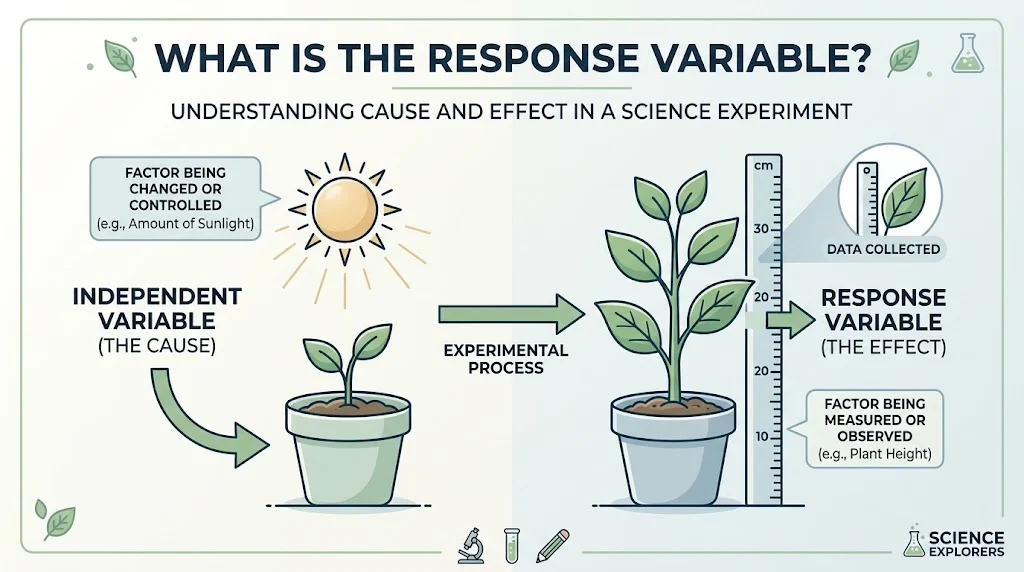
A response variable is the outcome you measure in an experiment or study to see how it changes when another variable is changed. It is also called the dependent variable because researchers study how it responds to different conditions.
Top alternatives: dependent variable, outcome variable, measured variable, experimental result, observed outcome
Ever wondered how scientists figure out whether something actually works? Maybe they want to know if more sunlight helps plants grow, if studying longer improves test scores, or if exercise affects heart rate. In each case, they need something to measure, and that is where the response variable comes in. Understanding this concept makes science experiments, statistics homework, and research projects much easier to understand.
The response variable tells you what happened, while the explanatory or independent variable helps explain why it happened. Once you know the difference, identifying variables becomes much less confusing. Whether you are answering a classroom question, preparing a science project, or explaining research to a friend, this guide gives you clear definitions, practical examples, and ready-to-use responses for different situations.
Simple Responses
- “It is the variable you measure in an experiment.”
Example: Use this when a classmate asks for a basic definition.
Meaning: It explains the main purpose of a response variable in simple words. - “It shows the outcome of a study.”
Example: Use this when explaining how researchers measure results.
Meaning: It highlights that the variable represents the result being observed. - “It is what changes in response to another variable.”
Example: Use this when describing a plant-growth experiment.
Meaning: It explains how the measured outcome may respond to different conditions. - “Think of it as the result you are looking for.”
Example: Use this when helping a beginner understand experimental variables.
Meaning: It connects the scientific term to an everyday idea. - “It is usually called the dependent variable.”
Example: Use this when answering a science worksheet.
Meaning: It gives another common name for the same concept. - “It is the outcome researchers observe.”
Example: Use this when discussing a research study.
Meaning: It describes what investigators record or measure. - “It is the answer your experiment helps you discover.”
Example: Use this when introducing an experiment to younger students.
Meaning: It describes the role of the measured result. - “It is the thing you collect data about.”
Example: Use this when explaining an experiment to a friend.
Meaning: It identifies what the researcher measures or records. - “It tells you what happened during the experiment.”
Example: Use this when summarizing an experiment’s results.
Meaning: It focuses on the observed outcome. - “It is the variable you want to understand or predict.”
Example: Use this when discussing a statistical model.
Meaning: It describes the role of the outcome in many research questions. - “It is the measured result, not the condition you change.”
Example: Use this when someone confuses the two main variables.
Meaning: It distinguishes the response variable from the independent variable. - “It is the outcome recorded during a study.”
Example: Use this when writing a research summary.
Meaning: It emphasizes the collection of measurable information. - “It is what the experiment is trying to explain.”
Example: Use this when discussing a research question.
Meaning: It connects the measured outcome to the purpose of the study. - “It is the result that may depend on other factors.”
Example: Use this when explaining relationships between variables.
Meaning: It shows that the outcome may be associated with other variables. - “It is the main thing being measured.”
Example: Use this when giving a quick classroom answer.
Meaning: It provides a short and direct definition.
Funny Responses
- “It is the experiment’s main character.”
Example: Use this when explaining variables to a friend who enjoys humor.
Meaning: It makes the measured outcome sound like the star of the experiment. - “It is the result everyone is waiting for.”
Example: Use this when introducing the outcome of a science project.
Meaning: It emphasizes the importance of the measurement. - “It is what the experiment wants to spill.”
Example: Use this when making a casual science joke.
Meaning: It compares the result to a piece of gossip being revealed. - “It is the final score of the science experiment.”
Example: Use this when describing a sports-related experiment.
Meaning: It compares the measured outcome to a score. - “It is the part that answers, ‘So, what happened?’”
Example: Use this when explaining the concept in a group study session.
Meaning: It focuses on the question the measurement helps answer. - “It is the experiment’s report card.”
Example: Use this when discussing whether a treatment or method worked.
Meaning: It humorously compares the outcome to an evaluation. - “It is the result that gets all the attention.”
Example: Use this when explaining why researchers measure a particular outcome.
Meaning: It highlights the variable’s central role. - “It is the plot twist you measure.”
Example: Use this when an experiment produces an unexpected outcome.
Meaning: It adds humor to the idea of observing results. - “It is what the data is trying to tell you.”
Example: Use this when talking about a graph or dataset.
Meaning: It presents the outcome as the main message of the data. - “It is the experiment’s answer key, minus the magic.”
Example: Use this when someone wants a memorable explanation.
Meaning: It compares the measured result to an answer while recognizing that experiments require evidence. - “It is the number everyone keeps checking.”
Example: Use this when discussing an experiment that tracks measurements over time.
Meaning: It emphasizes the importance of the recorded outcome. - “It is what happens after the independent variable enters the chat.”
Example: Use this when explaining how variables relate to each other.
Meaning: It humorously describes the relationship between a changed condition and a measured outcome. - “It is the data’s big reveal.”
Example: Use this when presenting experimental results.
Meaning: It describes the outcome as the information revealed by the study. - “It is the experiment’s answer to the group project.”
Example: Use this when explaining the result of a classroom investigation.
Meaning: It compares the measured outcome to the final product of teamwork. - “It is what gets measured, not what gets blamed.”
Example: Use this when helping someone remember the definition.
Meaning: It makes the distinction between a measured outcome and its possible causes memorable.
Professional Responses
- “The response variable is the measured outcome of an investigation.”
Example: Use this in a formal research discussion.
Meaning: It provides a concise scientific definition. - “It represents the outcome used to evaluate a research question.”
Example: Use this in a research proposal.
Meaning: It connects the variable to the study’s objective. - “The response variable is the dependent variable in many experimental designs.”
Example: Use this in a science report.
Meaning: It identifies a commonly used alternative term. - “It is the variable observed to assess an effect or relationship.”
Example: Use this when describing a statistical analysis.
Meaning: It explains how researchers use the variable. - “It is the primary outcome measured in the study.”
Example: Use this in a formal presentation.
Meaning: It identifies the study’s main measurement. - “Researchers analyze it to understand patterns in the data.”
Example: Use this when explaining data analysis.
Meaning: It describes how the measured outcome supports interpretation. - “Its values provide evidence relevant to the research question.”
Example: Use this in an academic paper.
Meaning: It explains why the measurements matter. - “It is recorded to evaluate differences between experimental conditions.”
Example: Use this when comparing treatment groups.
Meaning: It describes a common purpose of measuring outcomes. - “It is the outcome variable selected for analysis.”
Example: Use this in a statistics assignment.
Meaning: It describes the variable’s role in data analysis. - “It may be measured numerically or categorized by type.”
Example: Use this when explaining different forms of data.
Meaning: It notes that response variables can be quantitative or categorical. - “Its relationship with explanatory variables is examined.”
Example: Use this when describing a statistical model.
Meaning: It explains how researchers investigate associations. - “It is defined according to the study’s objectives.”
Example: Use this when planning a research project.
Meaning: It emphasizes selecting a measurement that matches the research question. - “It provides the outcome data used to assess a hypothesis.”
Example: Use this in a scientific report.
Meaning: It connects the measured variable to hypothesis testing. - “Its measurement method should be clearly specified.”
Example: Use this when reviewing an experimental plan.
Meaning: It emphasizes consistent and transparent data collection. - “It helps quantify the phenomenon being investigated.”
Example: Use this in a technical explanation.
Meaning: It describes how the variable turns an observation into usable data.
Confident Responses
- “The response variable is what you measure.”
Example: Use this when answering a direct classroom question.
Meaning: It gives the core definition without unnecessary detail. - “The independent variable is what you change; the response variable is what you measure.”
Example: Use this when comparing the two variables.
Meaning: It gives a straightforward way to distinguish their roles in an experiment. - “Look for the outcome in the research question.”
Example: Use this when helping someone identify a variable.
Meaning: It suggests a practical way to recognize the response variable. - “Ask yourself what the researcher records.”
Example: Use this when solving a homework problem.
Meaning: It directs attention to the measurement. - “The response variable tells you what result is being observed.”
Example: Use this during a class discussion.
Meaning: It explains the concept confidently and clearly. - “Start with the measurement, and you can usually identify it.”
Example: Use this when reviewing an experiment.
Meaning: It offers a simple identification strategy. - “It is the outcome, not the treatment.”
Example: Use this when distinguishing an experimental treatment from its measured effect.
Meaning: It clarifies the difference between a condition and an outcome. - “The research question usually points you toward it.”
Example: Use this when planning a science project.
Meaning: It shows how to identify the relevant measurement. - “The measured result is the key clue.”
Example: Use this when interpreting a word problem.
Meaning: It emphasizes the importance of identifying what is recorded. - “Every good experiment needs a clearly defined outcome.”
Example: Use this when explaining experimental design.
Meaning: It highlights the value of selecting an appropriate response variable. - “The variable depends on what the study aims to measure.”
Example: Use this when discussing different research questions.
Meaning: It explains why the response variable changes from one study to another. - “Focus on the result, and the definition becomes easier.”
Example: Use this when helping a student remember the term.
Meaning: It offers a simple memory strategy. - “The outcome is the key; the other variables help explain it.”
Example: Use this when summarizing a statistical relationship.
Meaning: It separates the measured result from potential explanatory factors. - “Identify the measurement before labeling the variables.”
Example: Use this when organizing an experiment.
Meaning: It encourages a logical approach to variable identification. - “Once you know what is measured, you are halfway there.”
Example: Use this when tutoring a beginner.
Meaning: It reassures them that identifying variables can be manageable.
Creative Responses
- “Think of the independent variable as the question and the response variable as the result.”
Example: Use this when introducing experimental design.
Meaning: It creates a simple mental picture of the relationship. - “Imagine a plant experiment: height is the response, and sunlight is the condition being changed.”
Example: Use this when teaching students about plant growth.
Meaning: It demonstrates how an outcome is measured after changing a condition. - “In a study of sleep and concentration, concentration is the response variable.”
Example: Use this when giving an everyday example.
Meaning: It shows how researchers measure an outcome associated with sleep. - “Think of it as the thermometer reading in a temperature experiment.”
Example: Use this when explaining a study involving heat.
Meaning: It compares a measured outcome to a familiar instrument reading. - “If the question asks whether practice improves scores, the score is the response.”
Example: Use this when discussing a learning experiment.
Meaning: It identifies the result researchers would measure. - “Imagine a recipe test: taste ratings are the response variable.”
Example: Use this when comparing different recipes.
Meaning: It shows how a subjective rating can serve as an outcome measure. - “In a study of exercise and heart rate, heart rate is the response.”
Example: Use this when discussing physical activity research.
Meaning: It identifies the physiological measurement. - “For a fertilizer experiment, plant growth could be the response.”
Example: Use this when describing a gardening investigation.
Meaning: It illustrates a measurable result of different fertilizer conditions. - “In a test of study methods, exam scores can be the response.”
Example: Use this when comparing learning strategies.
Meaning: It identifies the outcome used to evaluate performance. - “For an advertising study, purchase intention could be the response.”
Example: Use this when discussing consumer research.
Meaning: It shows that outcomes do not always have to be physical measurements. - “In a weather study, daily rainfall could be the response.”
Example: Use this when describing environmental research.
Meaning: It identifies a measurable weather outcome. - “For a traffic study, travel time might be the response.”
Example: Use this when comparing road conditions.
Meaning: It shows how researchers measure the effect of different traffic conditions. - “In a customer survey, satisfaction ratings may be the response.”
Example: Use this when discussing business research.
Meaning: It identifies a rating used to represent customer experience. - “In a battery test, operating time can be the response.”
Example: Use this when comparing battery types.
Meaning: It explains how a duration can be measured as an outcome. - “In a classroom study, attendance or test performance may be the response.”
Example: Use this when discussing education research.
Meaning: It shows that the correct outcome depends on the study’s purpose.
Sarcastic Responses
- “It is the thing you measure, not the thing you randomly blame.”
Example: Use this jokingly when someone confuses variables.
Meaning: It emphasizes the difference between measurement and assumptions. - “Science wants data, not your best guess.”
Example: Use this when a classmate guesses the outcome.
Meaning: It highlights the importance of recording actual observations. - “The response variable is not hiding; check what is being measured.”
Example: Use this when someone struggles with a worksheet.
Meaning: It humorously directs them toward the key information. - “No, the independent variable does not get every job.”
Example: Use this when someone labels every variable as independent.
Meaning: It jokes about confusing the roles of variables. - “Plot twist: the result is the response variable.”
Example: Use this when explaining the definition to a friend.
Meaning: It turns the main concept into a simple joke. - “Measure first, overthink later.”
Example: Use this when a student gets stuck on a problem.
Meaning: It encourages identifying the measurement before complicating the question. - “The experiment needs an outcome, not a dramatic speech.”
Example: Use this when explaining a research report.
Meaning: It humorously emphasizes the importance of measurable results. - “If it is what you record, you are getting warmer.”
Example: Use this during a study session.
Meaning: It gives a playful clue for identifying the variable. - “Guessing the variable is not a scientific method.”
Example: Use this when someone guesses without reading the question.
Meaning: It encourages careful analysis. - “The graph is not going to label itself.”
Example: Use this when interpreting a chart.
Meaning: It jokes about the need to understand the variables. - “Read the question before blaming the data.”
Example: Use this when someone misunderstands an experiment.
Meaning: It encourages reading carefully before drawing conclusions. - “The response variable has one job: represent the outcome.”
Example: Use this when explaining the concept.
Meaning: It simplifies the variable’s purpose. - “Science class really said, ‘Define your results.’”
Example: Use this when reviewing research terminology.
Meaning: It humorously references the importance of clear definitions. - “The result cannot speak if you never measure it.”
Example: Use this when discussing data collection.
Meaning: It highlights why recording outcomes matters. - “Less guessing, more actual measurements.”
Example: Use this when someone jumps to conclusions.
Meaning: It promotes evidence-based thinking.
Cute Responses
- “It is simply the result your experiment is watching.”
Example: Use this when helping a younger student understand the term.
Meaning: It offers a gentle, approachable explanation. - “Think of it as the little answer your experiment discovers.”
Example: Use this when introducing a science activity.
Meaning: It makes the outcome sound easy to understand. - “It is the part you check to see what happened.”
Example: Use this when explaining a simple experiment.
Meaning: It describes the act of measuring the outcome. - “It is the result that helps complete the science story.”
Example: Use this when explaining a classroom investigation.
Meaning: It shows how measurements contribute to understanding. - “It is what the experiment keeps an eye on.”
Example: Use this when describing an ongoing study.
Meaning: It emphasizes what researchers observe. - “It is the answer hidden inside your data.”
Example: Use this when talking about a graph.
Meaning: It presents the measured outcome as useful information. - “It is what you measure with curiosity.”
Example: Use this when encouraging students to explore science.
Meaning: It connects measurement with discovery. - “It helps your experiment tell its story.”
Example: Use this when summarizing a science project.
Meaning: It describes how results explain what happened. - “It is the result you are keeping track of.”
Example: Use this when explaining a repeated measurement.
Meaning: It identifies the recorded outcome. - “It is what you observe as your experiment unfolds.”
Example: Use this when discussing a process over time.
Meaning: It describes observing an outcome as conditions change. - “It is the little clue that helps answer your question.”
Example: Use this when helping someone plan a study.
Meaning: It explains the value of measuring an outcome. - “It is the part that makes your data useful.”
Example: Use this when discussing why measurements matter.
Meaning: It emphasizes the usefulness of collected information. - “It is what your experiment wants you to notice.”
Example: Use this when introducing a science topic.
Meaning: It encourages attention to the outcome. - “It is the measurement that helps things make sense.”
Example: Use this when interpreting results.
Meaning: It highlights the role of the outcome in understanding data. - “It is the answer you discover, one measurement at a time.”
Example: Use this when encouraging a student to finish an experiment.
Meaning: It makes scientific investigation sound approachable.
Chill And Casual Responses
- “It is basically what you measure.”
Example: Use this in a relaxed conversation about homework.
Meaning: It gives a quick, informal definition. - “It is the result of the experiment.”
Example: Use this when someone wants a simple explanation.
Meaning: It identifies the measured outcome. - “It is what you are checking in the study.”
Example: Use this when discussing a science assignment.
Meaning: It explains what the researcher observes. - “Think of it as the outcome.”
Example: Use this when explaining the term casually.
Meaning: It gives a short synonym. - “It is the thing you record in your data table.”
Example: Use this when working through an experiment.
Meaning: It links the concept to practical data collection. - “It is what you want to find out.”
Example: Use this when describing a research question.
Meaning: It connects the variable to the purpose of the study. - “It is the measured part of the experiment.”
Example: Use this when comparing variables.
Meaning: It emphasizes the measurement role. - “It is the result you look at afterward.”
Example: Use this when discussing an experiment’s conclusion.
Meaning: It identifies the outcome researchers examine. - “It is the answer your data gives you.”
Example: Use this when discussing recorded measurements.
Meaning: It connects data with the observed result. - “It is the thing that might change when conditions change.”
Example: Use this when discussing experimental conditions.
Meaning: It explains the possible relationship between variables. - “It is what you track during the experiment.”
Example: Use this when describing repeated measurements.
Meaning: It identifies the observed variable. - “It is the outcome you compare between groups.”
Example: Use this when discussing an experiment with two groups.
Meaning: It explains how researchers use outcomes to compare conditions. - “It is what the researcher wants to explain.”
Example: Use this when describing a research study.
Meaning: It identifies the focus of the analysis. - “It is the variable on the results side.”
Example: Use this when distinguishing between variables.
Meaning: It offers a simple way to remember the concept. - “It is the measured answer, basically.”
Example: Use this when someone wants a very short response.
Meaning: It summarizes the definition in casual language.
Emotional Responses
- “It helps show what actually happened, not just what we expected.”
Example: Use this when explaining why measurements matter.
Meaning: It highlights the difference between expectations and observations. - “It gives researchers something real to work with.”
Example: Use this when discussing evidence in a study.
Meaning: It emphasizes the value of collected data. - “It helps turn a question into something measurable.”
Example: Use this when planning a research project.
Meaning: It explains how a research question can become a measurable investigation. - “It helps us understand whether a change made a difference.”
Example: Use this when comparing two experimental conditions.
Meaning: It describes how measured outcomes can help assess differences. - “It is an important part of making sense of the results.”
Example: Use this when reviewing an experiment.
Meaning: It explains why identifying the outcome matters. - “It shows what the evidence says about the question.”
Example: Use this when summarizing research findings.
Meaning: It connects measurements to evidence. - “It helps researchers move beyond assumptions.”
Example: Use this when explaining scientific reasoning.
Meaning: It emphasizes the role of evidence in understanding outcomes. - “It gives the experiment a clear focus.”
Example: Use this when describing experimental planning.
Meaning: It explains how a defined outcome guides the study. - “It helps reveal patterns that might otherwise go unnoticed.”
Example: Use this when discussing a large dataset.
Meaning: It highlights how measurements support discovering trends. - “It is one way to find evidence for an idea.”
Example: Use this when explaining hypothesis testing.
Meaning: It describes the role of outcomes in evaluating a claim. - “It makes it possible to compare what happened under different conditions.”
Example: Use this when comparing groups in a study.
Meaning: It explains how response measurements support comparisons. - “It helps connect the research question to the evidence.”
Example: Use this when writing a report.
Meaning: It shows how a measured outcome relates to the study’s purpose. - “It reminds us to look at the results, not only our expectations.”
Example: Use this when discussing a surprising outcome.
Meaning: It encourages objective interpretation. - “It helps make a scientific conclusion more meaningful.”
Example: Use this when explaining the final stage of a study.
Meaning: It highlights how outcome measurements inform conclusions. - “It gives us a clearer picture of the situation.”
Example: Use this when explaining why researchers collect data.
Meaning: It describes how measurements improve understanding.
Clever Responses
- “Find the verb ‘measure’ in the question, and look for what follows.”
Example: Use this as a study tip for identifying variables.
Meaning: It encourages looking for the outcome being recorded. - “Ask what the researcher is trying to predict or explain.”
Example: Use this when interpreting a statistical question.
Meaning: It directs attention to the outcome of interest. - “The response variable is often the ‘Y’ in a model.”
Example: Use this when discussing a simple statistical equation.
Meaning: It notes that outcomes are often represented by , though notation can vary. - “Separate what is changed from what is measured.”
Example: Use this when analyzing an experiment.
Meaning: It provides a useful method for distinguishing variables. - “If it is the outcome being recorded, it may be the response variable.”
Example: Use this when examining a study description.
Meaning: It offers a practical identification clue. - “A variable’s role depends on the research question.”
Example: Use this when comparing different studies using similar measurements.
Meaning: It explains that the same variable can serve different roles in different studies. - “Do not confuse correlation with proof of causation.”
Example: Use this when interpreting an observational study.
Meaning: It reminds readers that a relationship between variables does not automatically establish cause and effect. - “Identify the outcome before choosing the graph.”
Example: Use this when preparing to visualize research data.
Meaning: It encourages clear planning before data presentation. - “Check whether the outcome is numerical or categorical.”
Example: Use this when selecting a statistical method.
Meaning: It highlights an important feature of the response variable. - “The response variable is defined by the question, not by its name.”
Example: Use this when a variable’s label seems confusing.
Meaning: It emphasizes the importance of the research context. - “An outcome can be a measurement, a count, or a category.”
Example: Use this when explaining different data types.
Meaning: It shows that response variables are not always continuous numbers. - “The best response variable directly matches the research objective.”
Example: Use this when planning an experiment.
Meaning: It emphasizes choosing an appropriate outcome. - “A clear definition makes the analysis easier to interpret.”
Example: Use this when preparing a report.
Meaning: It explains why defining variables precisely matters. - “Look at the data column that represents the outcome.”
Example: Use this when reviewing a spreadsheet.
Meaning: It gives a practical way to locate the response variable. - “Measure the outcome consistently, and comparisons become more useful.”
Example: Use this when designing a repeated experiment.
Meaning: It emphasizes consistency in data collection.
Sweet Responses
- “It is simply the result your experiment is trying to understand.”
Example: Use this when helping a classmate who feels confused.
Meaning: It makes the definition sound approachable. - “Think of it as the answer your measurements help reveal.”
Example: Use this when explaining the term to a beginner.
Meaning: It connects the variable to the discovery process. - “Once you find what is being measured, you are on the right track.”
Example: Use this when helping someone with homework.
Meaning: It offers encouragement and a practical clue. - “You do not need complicated words to understand it.”
Example: Use this when someone feels overwhelmed by scientific vocabulary.
Meaning: It reassures them that the concept can be learned simply. - “Start with the outcome, and the rest gets easier.”
Example: Use this when tutoring a student.
Meaning: It encourages a straightforward learning strategy. - “It is the part that helps your experiment answer its question.”
Example: Use this when introducing a science activity.
Meaning: It connects the measurement to the research goal. - “You can remember it as the thing you check at the end.”
Example: Use this when teaching the basic idea.
Meaning: It provides an easy memory aid, although outcomes may also be measured throughout an experiment. - “Every measurement gives you another piece of the picture.”
Example: Use this when discussing repeated observations.
Meaning: It shows how data contributes to understanding. - “It is okay if the terminology takes a little practice.”
Example: Use this when a student struggles to remember the definition.
Meaning: It normalizes the learning process. - “One clear example can make the whole concept click.”
Example: Use this when preparing someone for a science test.
Meaning: It encourages learning through practical examples. - “Think about what changes, and then ask what gets measured.”
Example: Use this when comparing variables in an experiment.
Meaning: It offers a helpful way to identify the outcome. - “You are learning to read experiments like a scientist.”
Example: Use this when encouraging a student during revision.
Meaning: It reinforces confidence in scientific thinking. - “The result does not have to be complicated to be useful.”
Example: Use this when explaining a simple experiment.
Meaning: It highlights the value of basic measurements. - “Keep asking what the study is trying to find out.”
Example: Use this when solving research questions.
Meaning: It encourages a reliable way to identify the response variable. - “You have got this: find the outcome, then name the variable.”
Example: Use this when helping someone prepare for a quiz.
Meaning: It gives an encouraging, easy-to-follow strategy.
FAQs
What Is a Response Variable?
A response variable is the outcome measured or observed in a study. Researchers examine it to answer a research question or understand a relationship between variables.
Is a Response Variable the Same as a Dependent Variable?
In many experimental and statistical contexts, yes. The terms are often used interchangeably, although terminology can vary by field and study design.
What Is the Difference Between an Independent and a Response Variable?
The independent variable is the factor researchers change or use as a predictor. The response variable is the outcome they measure or seek to explain.
What Is an Example of a Response Variable?
If a researcher studies how sunlight affects plant growth, plant height may be the response variable, while the amount of sunlight is the explanatory variable.
Can a Response Variable Be Categorical?
Yes. It can be numerical, such as height or temperature, or categorical, such as a yes-or-no outcome or a product preference category.
Conclusion
Understanding the response variable makes science experiments, statistics, and research questions much easier to approach. Remember the simplest rule: the response variable is the outcome you measure. Whether you are studying plant growth, exam scores, customer satisfaction, or heart rate, identifying the measured result helps you understand the purpose of the investigation.
Use the examples in this guide to practice distinguishing outcomes from the factors that may explain them. With a little practice, the concept becomes much easier to recognize in homework, reports, and real-world studies. Save this guide for your next study session, share it with a classmate, and keep making science simpler, one variable at a time!
Discover More Related Articles:
- Positive First Response Pregnancy Test | Sweet, Supportive & Clever Replies In 2026
- Curl Show Response Headers | Commands & Smart Replies In 2026
